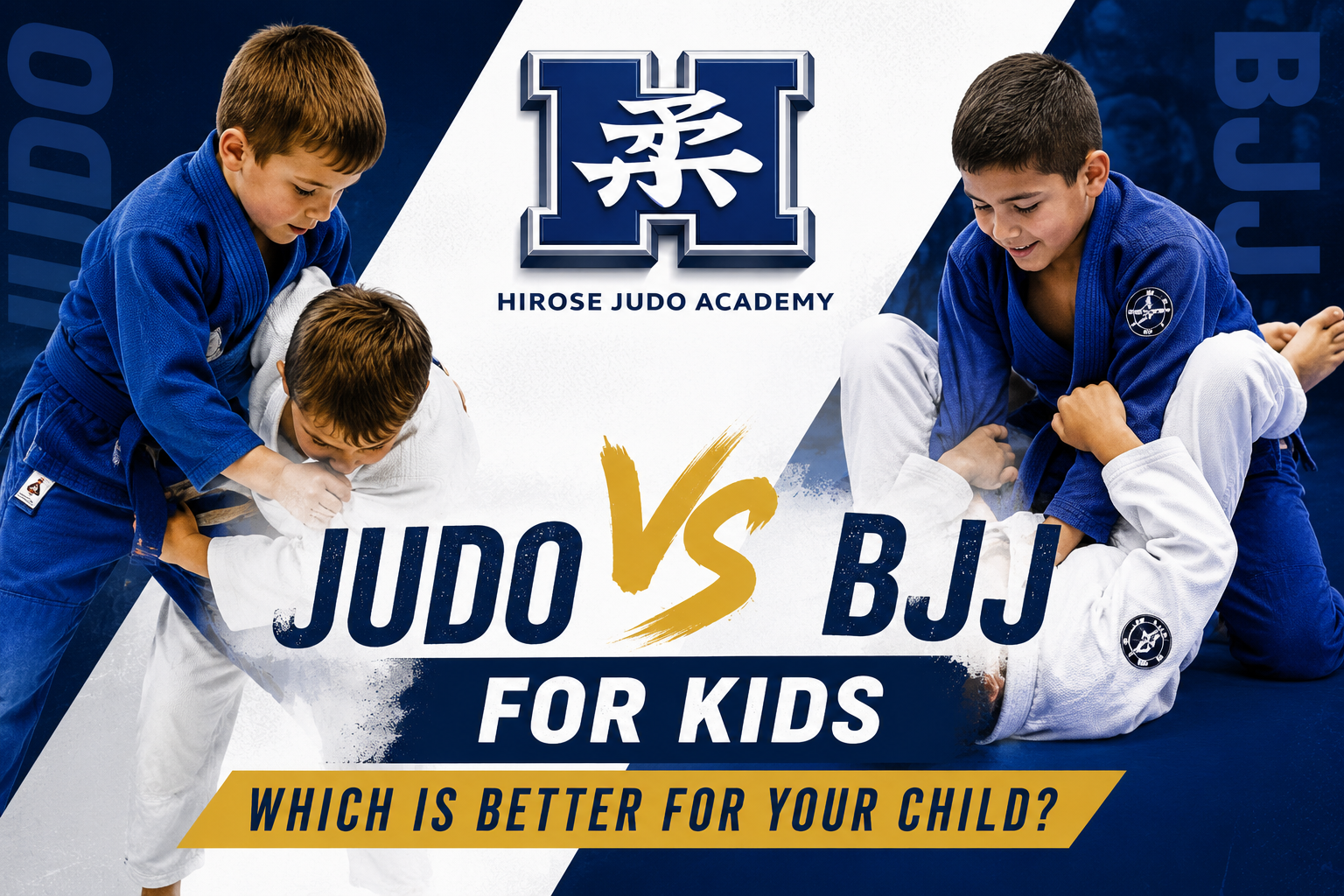
Judo vs BJJ for Kids: Which Is Better for Your Child?
Judo and Brazilian Jiu-Jitsu (BJJ) are both grappling-based martial arts, and they share some techniques and principles. However, the way children train and compete can be quite different.
Judo generally places greater emphasis on standing grappling, throws, balance and transitions into groundwork. BJJ generally spends more time developing groundwork, positional control and submissions.
Neither is automatically better for every child. The right choice depends on what your child enjoys, the quality of the coaching environment and what you want them to gain from martial arts.
Judo vs BJJ for Kids: Quick Comparison
| Area | Judo | BJJ |
|---|---|---|
| Main focus | Throws, balance, gripping and groundwork | Groundwork, positional control and submissions |
| Standing training | Major part of the sport | Varies significantly between academies |
| Groundwork | Yes, but more limited by judo rules and time | Central part of the sport |
| Throws and takedowns | Major emphasis | Included, but emphasis varies by academy |
| Safe falling | Fundamental skill taught from beginner level | May be taught, particularly where takedowns are practised |
| Competition | Strong international competitive pathway | Large and growing competition scene |
What Do Kids Learn in Judo?
Beginner judo should start with fundamentals rather than immediately putting children into hard competitive training.
Children learn how to fall safely, move with a partner, understand balance, grip appropriately and gradually perform throwing and groundwork techniques.
As they develop, they can learn how to apply those skills against a resisting partner through randori.
For a detailed explanation of the beginner pathway, read What Should Kids Learn First in Judo?
What Do Kids Learn in Brazilian Jiu-Jitsu?
Brazilian Jiu-Jitsu generally places much greater emphasis on grappling after the action reaches the ground.
Children may learn positional control, escapes, guard positions, transitions and age-appropriate submission techniques.
BJJ can therefore provide children with a deep understanding of how to move and solve problems while grappling on the ground.
The amount of standing grappling varies considerably between academies. Some programs regularly teach takedowns, while others spend most of the class starting from the ground.
Which Is Better for Balance and Coordination?
Both sports can develop coordination, but they challenge children in different ways.
Judo
Children spend significant time standing, moving while connected to another person, attacking balance and defending against throws.
This develops awareness of posture, footwork, timing and whole-body balance.
BJJ
Children learn to coordinate their arms, legs and body while controlling or escaping positions on the ground.
This can develop excellent body awareness and movement in complex grappling positions.
Judo vs BJJ for Confidence
Both judo and BJJ can provide opportunities for children to develop confidence.
In both sports, progress often comes from solving small problems: learning a new technique, escaping a difficult position, successfully performing a throw or becoming comfortable training with different partners.
Confidence should not come simply from winning. A healthy martial arts environment helps children become comfortable trying, failing, learning and trying again.
Which Is Better for Shy Kids?
Neither sport is automatically better for a shy child.
Both involve regular partner interaction, which can gradually help some children become more comfortable communicating and working physically with others.
The coaching environment matters more than the name of the martial art. A patient coach and appropriately structured beginner class can make a significant difference.
Which Is Safer for Kids: Judo or BJJ?
Both are contact sports, so neither is completely free from injury risk.
Judo involves falling and throwing, while BJJ involves close-contact groundwork and joint or submission positions.
For children, the quality of instruction is especially important. Beginners should learn progressively, practise with appropriate partners and be supervised carefully.
In judo, learning ukemi — safe falling — is one of the most important early skills.
Parents who want to understand this in more detail can read Is Judo Safe for Kids?
Judo vs BJJ for Self-Defence
Both sports teach useful grappling skills, but they develop different areas.
Judo places considerable emphasis on remaining balanced while standing, controlling grips and throwing another person. BJJ develops deeper skills in controlling, escaping and moving through positions on the ground.
However, parents should be cautious about choosing a children’s martial art solely because of claims about “real-world effectiveness.”
For children, awareness, confidence, avoiding unnecessary conflict and seeking help from an adult remain extremely important.
Which Has Better Competition Opportunities?
Both judo and BJJ offer competition opportunities, but their competitive structures are different.
Judo is an Olympic sport with established national and international pathways around the world.
BJJ also has a large international competition scene, with numerous tournaments and organisations offering events for children and adults.
Competition does not need to be the reason your child starts either sport. Children can benefit from martial arts without competing.
Can Kids Train Both Judo and BJJ?
Yes. The two sports can complement each other well.
Judo can strengthen standing grappling, gripping, balance and throwing skills, while BJJ can provide additional time developing groundwork.
However, younger children do not necessarily need to train multiple martial arts immediately.
Building strong fundamentals and enjoying regular training may be more important than trying to do everything at once.
Which Is Better for Beginners?
Both judo and BJJ can be suitable for complete beginners.
The bigger question is whether the specific class is actually designed to introduce children progressively.
Parents should look at how coaches manage new students, whether children are matched appropriately and whether basic skills are taught before harder live training.
How Should Parents Choose Between Judo and BJJ?
Think about what type of movement your child enjoys, but do not make the decision based only on the martial art itself.
Judo may suit children who enjoy:
- Throws and takedowns
- Standing grappling
- Balance and footwork
- Fast transitions between standing and ground
- Both throwing and groundwork
BJJ may suit children who enjoy:
- Ground grappling
- Positional problem-solving
- Escapes and control
- Longer groundwork exchanges
- A more ground-focused style of grappling
How Does Judo Compare With Other Martial Arts for Kids?
Judo and BJJ are only two of the options available to families. Karate, taekwondo and other martial arts develop different skills and may suit different children.
Compare the main martial arts for children
Read our complete guide to the best martial arts for kids to compare judo, BJJ, karate, taekwondo and other options before choosing a program.
Kids Judo on the Gold Coast
If your child would like to experience judo, Hirose Judo Academy provides structured kids judo classes on the Gold Coast for complete beginners through to competitive athletes.
Training begins with safe falling, movement and fundamental skills before children gradually progress into more challenging partner practice.
You can also learn more about Hirose Judo Academy on the Gold Coast and our overall coaching and development pathway.
Let Your Child Try Judo
The easiest way to know whether judo suits your child is to let them experience a class.
📍 Carrara, Gold Coast
🥋 Complete beginners welcome
⭐ Structured, age-appropriate training
🎁 Free trial available
Judo vs BJJ for Kids: Frequently Asked Questions
Is judo or BJJ better for kids?
Neither is automatically better. Judo generally places more emphasis on standing grappling, throws and balance, while BJJ generally places more emphasis on groundwork and positional control. The right choice depends on the child and the quality of the program.
Is judo harder than BJJ for kids?
They are challenging in different ways. Judo requires children to become comfortable with falling, throwing and standing balance, while BJJ requires them to understand detailed groundwork and positional movement.
Is judo or BJJ safer for children?
Both are contact sports. Appropriate coaching, progressive instruction, suitable training partners and good supervision are important for reducing unnecessary risk in either sport.
Should my child learn judo before BJJ?
There is no requirement to learn one before the other. Children can begin either sport as complete beginners.
Can children train both judo and BJJ?
Yes. Judo and BJJ can complement each other, particularly because judo develops standing grappling and throws while BJJ provides extensive groundwork practice.