
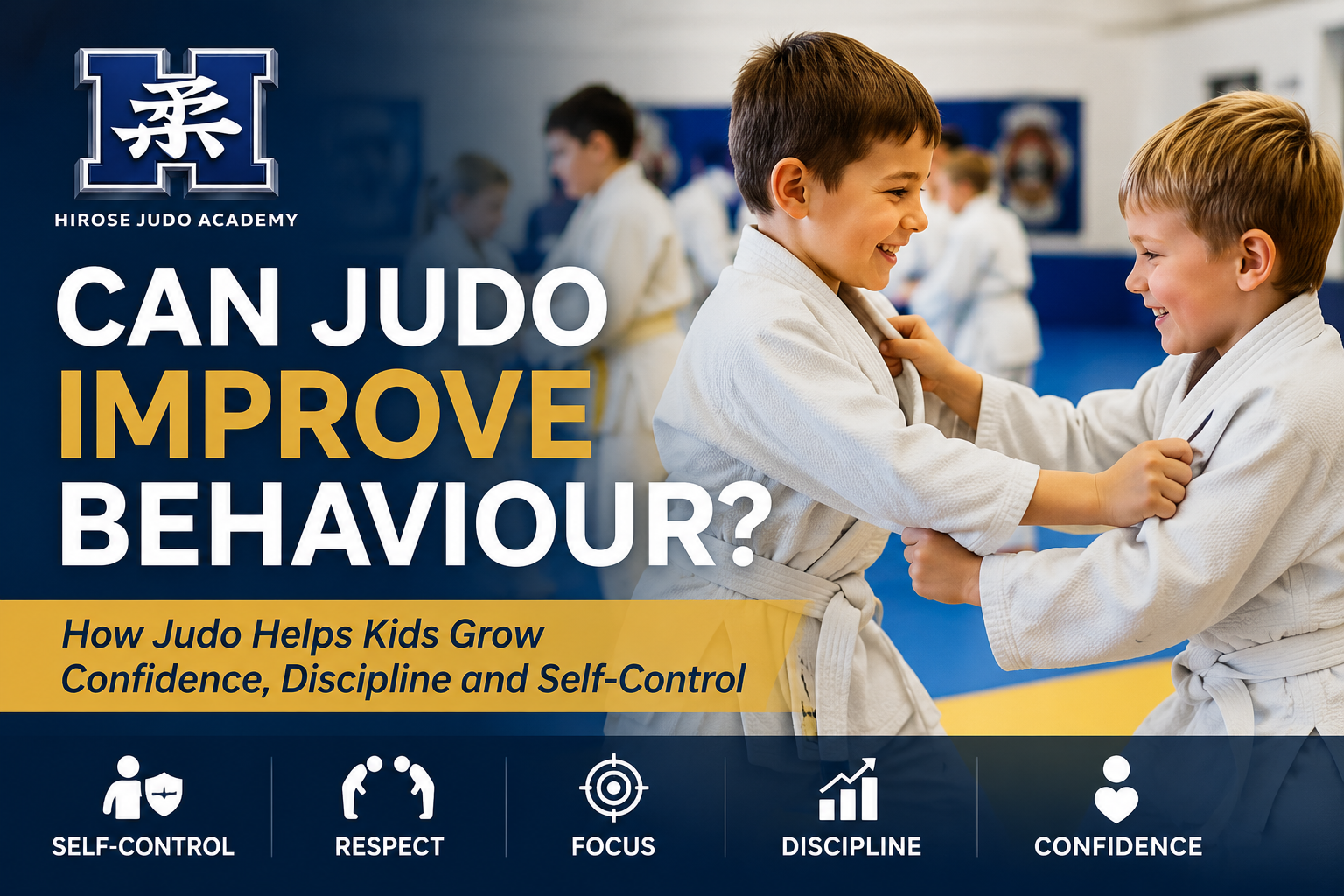
Many parents consider martial arts because they want their child to become more disciplined, focused or respectful. Judo can help support better behaviour, but not because children are simply told to “behave.” The real value comes from giving them a structured environment where actions, choices and consequences are experienced repeatedly.
Judo does not automatically change a child’s behaviour. However, with consistent training, clear expectations and good coaching, it can help children develop self-control, respect, patience, responsibility and the ability to manage frustration.
How Can Judo Help Improve Behaviour?
Children often learn behaviour more effectively through experience than through repeated instructions.
In a judo class, a child quickly learns that they need to listen before practising a technique, control their body when working with a partner, follow rules during training and manage their emotions when something does not go their way.
These lessons happen naturally, again and again.
Over time, this repeated experience can help children develop skills that may also support their behaviour outside the dojo.
1. Judo Teaches Children to Listen Before They Act
A judo class has structure. Students cannot simply do whatever they want whenever they want.
They need to stop, watch a demonstration, listen to instructions and then try the skill.
For some children, this can be difficult at first. They may become distracted, interrupt or start practising before the instruction is finished.
Good coaching does not expect instant perfection. Instead, children are repeatedly guided back to the same process:
- Stop
- Listen
- Watch
- Try
Over time, this routine can help develop better attention and impulse control.
2. Children Learn That Their Actions Affect Other People
Judo is not an activity children can do completely alone.
Every student needs a training partner. This means children must gradually learn how to work with someone else.
If they are too rough, their partner may not feel safe. If they do not cooperate, both children struggle to learn. If they ignore the rules, training has to stop.
This gives children immediate and understandable feedback.
They begin to learn that good behaviour is not only about avoiding punishment. It is also about creating a safe and positive environment for the people around them.
3. Judo Gives Children a Safe Place to Experience Frustration
Children do not always get what they want in judo.
A technique may not work. A partner may be stronger. They may lose during a game, struggle to learn a movement or make the same mistake many times.
These moments can create frustration.
But frustration is not always something children need to avoid. Learning how to experience disappointment without giving up, blaming others or losing control is an important part of development.
With the right support, judo can help children practise calming down, trying again and finding another solution.
4. Respect Is Practised, Not Just Discussed
Respect is an important part of judo culture.
Children bow, listen when someone is speaking, take care of their training partners and follow the rules of the dojo.
But respect should be more than a ceremony.
The deeper lesson is learning to recognise that coaches, training partners and other students all deserve consideration.
Children learn that being strong does not give them permission to hurt others, and that improving in judo also means helping others improve.
5. Judo Can Help Develop Self-Control
Judo is physical, but students cannot use their strength without control.
They need to learn when to attack, when to stop and how to practise safely with different partners.
A larger or more experienced child may need to adjust when training with a smaller beginner. An excited child may need to slow down and listen before continuing.
This creates regular opportunities to practise controlling both the body and emotions.
What Behavioural Skills Can Judo Support?
Listening
Children practise stopping and paying attention before beginning an activity.
Self-Control
Students learn to control their strength, movement and reactions.
Respect
Children learn to work safely and positively with coaches and training partners.
Responsibility
Students begin to understand how their choices affect their own training and other people.
Patience
Judo skills take time, repetition and consistent effort to develop.
Emotional Control
Children experience mistakes, frustration and setbacks in a supported environment.
Will Judo Fix Bad Behaviour?
No sport can guarantee that a child’s behaviour will suddenly change.
Judo should not be treated as a punishment or as a quick solution for every behavioural challenge.
Children are different. Some respond quickly to structure. Others need more time, repetition and support.
What matters most?
The quality of the environment, consistency of expectations, relationship with the coach and support from parents all matter.
The goal should not be to create a child who is simply quiet and obedient. A better goal is to help children develop the ability to make better choices, manage themselves and understand how their behaviour affects others.
What If My Child Struggles to Listen in Class?
Many children struggle with attention, patience or self-control when they first start.
This does not always mean judo is unsuitable for them.
In fact, learning how to participate in a structured group can be part of the development process.
A child may initially:
- Talk while the coach is explaining
- Become distracted
- Want to play instead of practise
- Become frustrated when a technique is difficult
- Struggle to lose during games or randori
The important question is not whether a child behaves perfectly from the first class.
The more useful question is whether they are gradually learning to listen, participate, control themselves and respond better to challenges.
How Long Does It Take to See a Change?
There is no single timeline.
Some parents may notice small changes within a few weeks. For other children, meaningful development may take months or longer.
Behavioural growth is rarely a straight line.
A child may improve, have a difficult week and then improve again. This is normal.
Consistent attendance is usually more valuable than expecting immediate results.
How Parents Can Support the Process
Parents can help by focusing on development rather than demanding perfect behaviour.
After class, instead of only asking:
“Did you win?”
parents can ask:
- What did you learn today?
- What was difficult?
- Did you help your training partner?
- What will you try again next time?
These questions reinforce the same skills that judo is trying to develop: reflection, responsibility, effort and resilience.
Why the Coaching Environment Matters
Judo itself is only part of the answer.
The culture of the dojo matters just as much.
Children need clear boundaries, but they also need to feel safe enough to make mistakes and learn.
At Hirose Judo Academy on the Gold Coast , we believe discipline should not simply mean punishment.
Good discipline helps children understand expectations, take responsibility and gradually develop the ability to manage themselves.
Our goal is not only to develop better judoka. We want to use judo as an environment where children can become more confident, respectful, resilient and responsible.
So, Can Judo Improve Behaviour?
Yes, judo can support better behaviour.
It gives children regular opportunities to practise listening, self-control, respect, patience and emotional regulation.
But the benefits do not come from simply wearing a judo uniform or attending a few classes.
They develop through consistent training, clear expectations, positive coaching and time.
More Resources for Parents
Kids Judo Classes on the Gold Coast Is Judo Safe for Kids? Does Judo Build Confidence in Kids? What Should Kids Learn First in Judo? Why Losing Can Be Good for Young AthletesFrequently Asked Questions
Can judo help a child who does not listen?
Judo can provide regular practice in stopping, listening, watching and following instructions. Progress depends on the individual child, the coaching environment and consistent attendance.
Does judo teach discipline?
Yes. Judo can help children practise discipline through structured classes, clear expectations, repetition, responsibility and controlled partner training.
Can judo help with anger or frustration?
Judo gives children opportunities to experience difficulty and frustration in a structured environment. With good guidance, they can practise calming down, trying again and responding more positively to setbacks.
Will judo immediately fix bad behaviour?
No. Judo is not a quick fix. Behavioural development usually requires time, consistency, appropriate coaching and support from both the dojo and family.
Does my child need to compete to benefit from judo?
No. Children can develop confidence, discipline, respect, coordination and resilience without competing.
Try Kids Judo on the Gold Coast
Help your child build confidence, discipline, resilience and real judo skills in a safe and supportive environment.
Book a Free Trial