Judo vs Taekwondo for Kids: Which Is Better for Your Child?
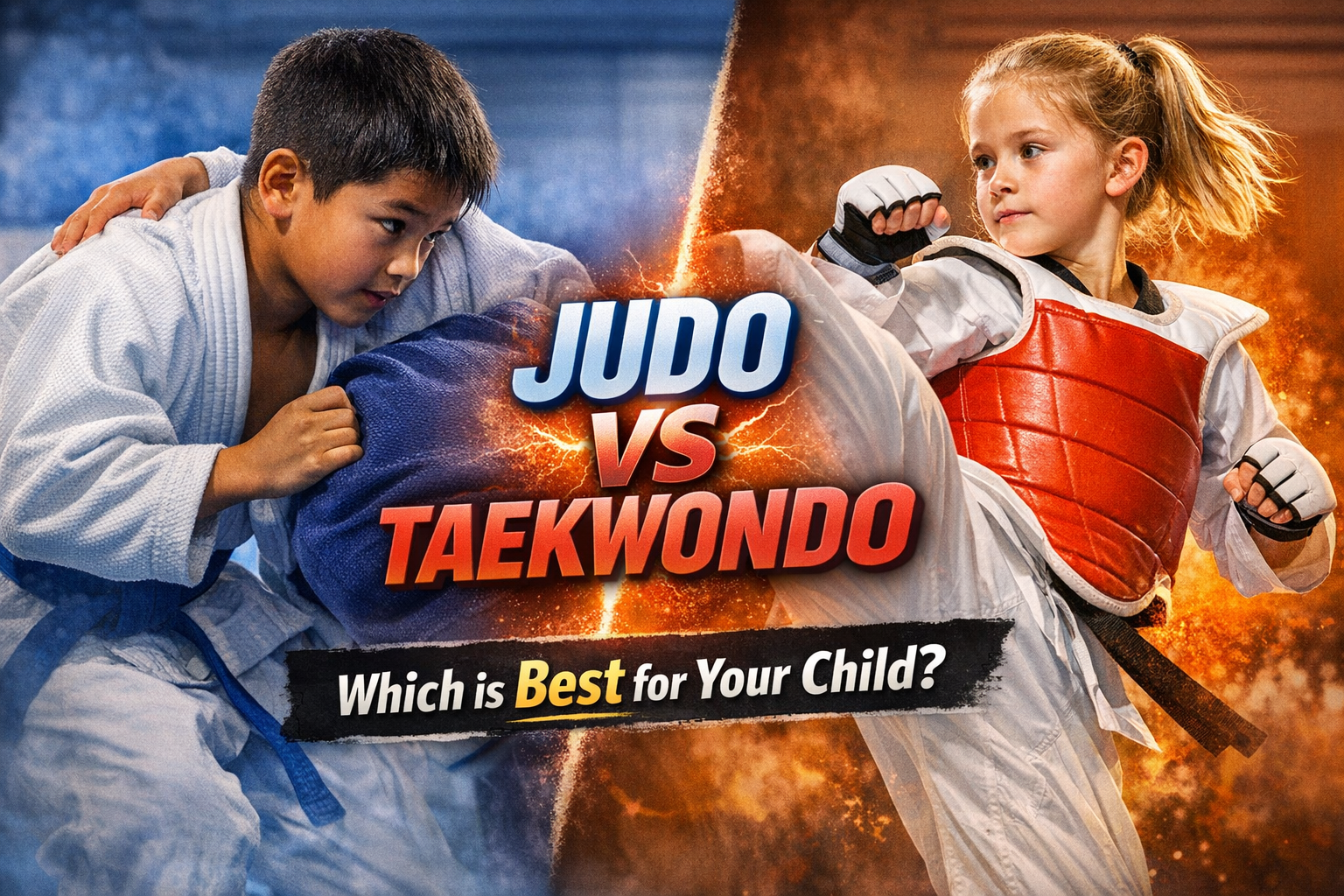
Judo and taekwondo can both be excellent martial arts for children, but they teach very different skills. Judo focuses primarily on throws, balance, gripping and control, while taekwondo places much greater emphasis on kicking, speed and movement at distance.
Neither martial art is automatically better for every child. The right choice depends on your child’s personality, interests, preferred style of movement and the quality of the club and coach.
This guide explains the main differences between judo and taekwondo so parents can make a more informed decision.
Judo vs Taekwondo: The Main Difference
| Area | Judo | Taekwondo |
|---|---|---|
| Main focus | Throws, balance, control and groundwork | Kicks, speed and striking movement |
| Typical distance | Close contact | Longer distance |
| Partner contact | High | Generally lower than judo |
| Falling skills | A fundamental part of training | Not a primary focus |
| Groundwork | Yes | Generally no |
| Competition | Throws, pins and submissions within age-appropriate rules | Primarily kicking and striking under competition rules |
What Do Children Learn in Judo?
Children learning judo do much more than practise throwing techniques. Good beginner training develops movement, balance, coordination, safe falling and the ability to work appropriately with a partner.
One of the first important skills is ukemi — learning how to fall safely. Children then gradually develop basic throwing and groundwork skills before progressing to more challenging partner practice.
If you want a more detailed explanation of the beginner pathway, read What Should Kids Learn First in Judo?
What Do Children Learn in Taekwondo?
Taekwondo training generally places greater emphasis on kicking techniques, footwork, speed, flexibility and striking combinations.
Children who enjoy fast movement, kicking and practising techniques from distance may naturally enjoy taekwondo.
The exact training experience varies significantly between clubs, so parents should observe an actual class rather than choosing solely based on the martial art’s name.
Which Is Better for Shy or Less Confident Children?
There is no rule that shy children should choose judo or confident children should choose taekwondo. Personality alone should not determine the martial art.
However, judo provides regular structured interaction with training partners. Children practise gripping, movement, throwing and groundwork together, which can gradually help them become more comfortable working closely with others.
Progress also happens through small achievable steps: learning to fall safely, completing a technique, practising with a partner and gradually becoming comfortable with more challenging training.
For some children, this type of structured partner interaction can be a positive environment for developing confidence.
Judo vs Taekwondo: Which Is Safer for Kids?
Parents often ask this question, but there is no useful answer based only on the name of the martial art.
Both judo and taekwondo are physical sports. Judo involves throwing and close contact, while taekwondo involves kicking and striking.
What matters enormously for children is how the training is organised: coaching quality, appropriate progression, training partners, class supervision and whether techniques are introduced at the right time.
For parents, look for a club that:
- Teaches beginners progressively
- Uses age-appropriate training
- Supervises partner practice carefully
- Does not rush children into hard competition
- Prioritises fundamentals before advanced techniques
- Creates clear expectations around behaviour and respect
For more information about judo specifically, see Is Judo Safe for Kids?
Which Is Better for Fitness and Coordination?
Both sports can help children become more physically active and develop coordination.
Judo
Judo develops whole-body coordination through pulling, pushing, turning, balancing, falling, throwing and moving against another person’s resistance.
Taekwondo
Taekwondo develops coordination through kicking, rapid footwork, balance, flexibility and repeated striking movements.
The better choice is usually the activity your child enjoys enough to practise consistently.
Which Is Better for Self-Defence?
Parents sometimes choose martial arts because they want their child to become more capable of protecting themselves.
Judo teaches balance, gripping, close-contact movement, throwing and controlling another person. Taekwondo develops striking, kicking, distance management and movement.
These are different skill sets, and neither should be presented to children as a guarantee of safety in a real confrontation.
For children, confidence, awareness, avoiding unnecessary conflict and knowing when to seek help are at least as important as learning physical techniques.
Does Your Child Need to Compete?
No.
Children can benefit from martial arts without competing. Competition can become an additional development opportunity for children who enjoy it and are ready for it, but it does not need to be the goal for every student.
At Hirose Judo Academy, children can begin with strong fundamentals and progress toward competition if that later becomes appropriate for their goals.
How Should Parents Choose Between Judo and Taekwondo?
Instead of asking only which martial art is better, ask which training environment is better for your child.
Judo may appeal to your child if they enjoy:
- Throwing and grappling
- Close partner interaction
- Balance and physical problem-solving
- Groundwork
- Learning through controlled resistance
Taekwondo may appeal to your child if they enjoy:
- Kicking
- Fast movement
- Training at greater distance
- Flexibility-based skills
- Striking combinations
Most importantly, visit the club. Watch how the coach communicates with children, how beginners are treated and how the class is structured.
A high-quality club in either martial art is usually a better choice than selecting a style based purely on general comparisons online.
Kids Judo on the Gold Coast
For families on the Gold Coast who want to experience judo, Hirose Judo Academy provides structured classes for children from complete beginners through to competitive athletes.
Our approach starts with safe falling, movement, strong technical foundations and age-appropriate partner practice. Competition pathways are available for children who want to progress further, but children do not need to compete to train with us.
Learn more about our kids judo classes on the Gold Coast , including beginner training and class options.
You can also explore Hirose Judo Academy on the Gold Coast to learn more about our coaching approach and training pathways.
Let Your Child Experience Judo
Reading comparisons can help, but the best way to know whether your child enjoys judo is to experience a real class.
📍 Hirose Judo Academy — Carrara, Gold Coast
🥋 Complete beginners welcome
⭐ Structured, age-appropriate training
🎁 Free trial available
Judo vs Taekwondo for Kids: Frequently Asked Questions
Is judo or taekwondo better for kids?
Neither is automatically better. Judo focuses primarily on throwing, balance, grappling and control, while taekwondo focuses more heavily on kicking, striking, speed and movement at distance. The best choice depends on the child and the quality of the club.
Is judo good for shy children?
Judo provides structured partner interaction and gradual technical progression, which some shy children may find helpful for developing confidence. However, every child is different and the coaching environment matters greatly.
Which is safer for children, judo or taekwondo?
Both are physical sports with different types of contact. Coaching quality, appropriate progression, supervision and the training environment are important safety factors in either sport.
Does my child need to compete in judo?
No. Children can train recreationally and develop judo skills without entering competitions.
Can my child try judo before joining?
Yes. Hirose Judo Academy offers a free trial so families can experience a class before deciding whether to continue.