Judo vs Karate for Kids: Which Is Better for Your Child?
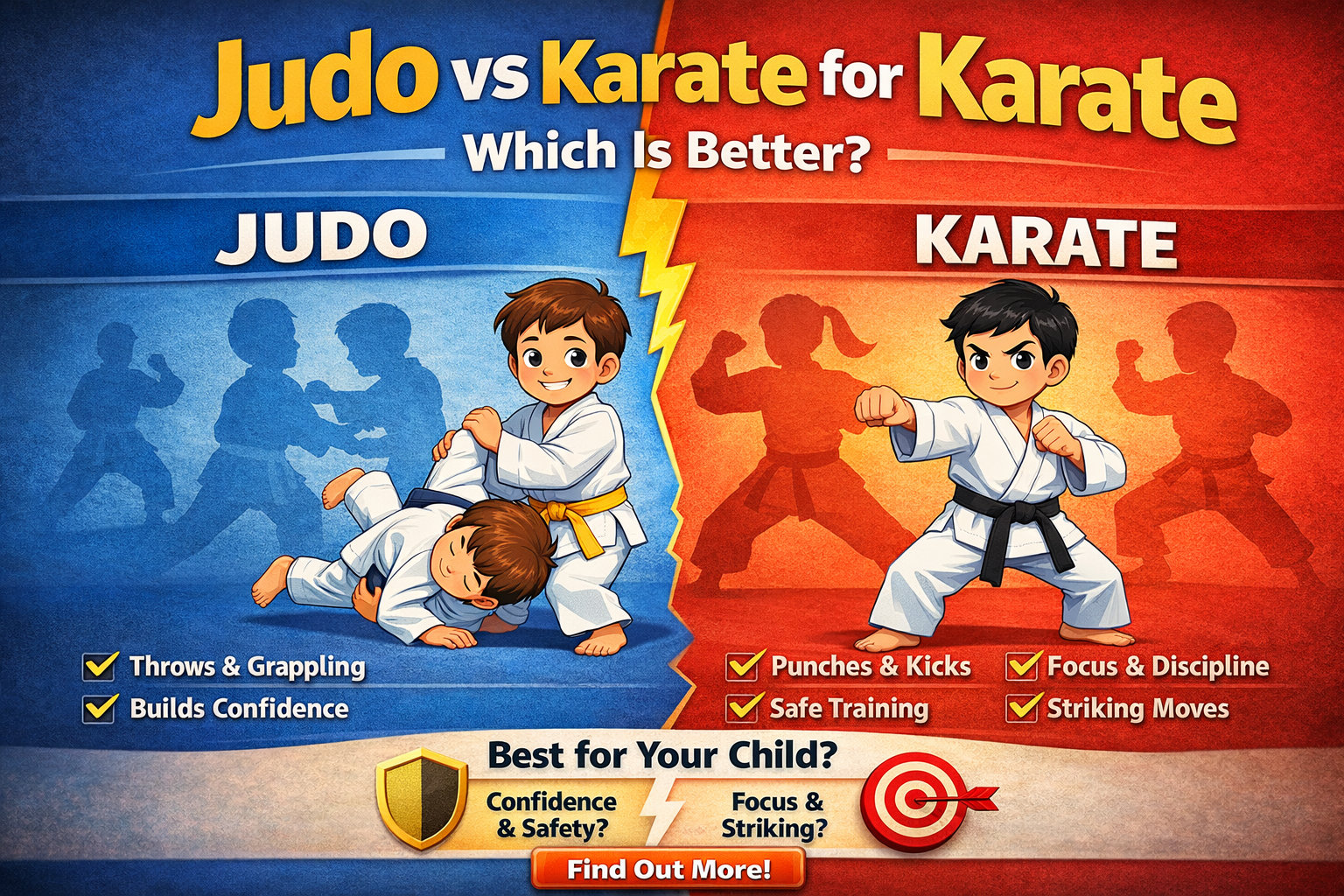
Judo and karate can both help children become fitter, more confident and more disciplined, but they teach through very different types of movement. The best choice depends on your child’s personality, comfort with contact, learning style and goals.
Parents comparing judo vs karate for kids are often trying to answer several questions at once:
- Which martial art is safer?
- Which one builds more confidence and discipline?
- Which is better for self-defence?
- Which suits a shy, energetic or highly competitive child?
- Which activity will my child actually enjoy enough to continue?
Both martial arts can be excellent when taught in a safe, age-appropriate and supportive environment. The quality of the coach and class matters at least as much as the style itself.
Judo or Karate for Kids: A Quick Choice
Judo may suit your child if they:
- Enjoy active partner-based learning
- Like wrestling, rolling or physical movement
- Would benefit from improving balance and coordination
- Need to become more comfortable with controlled contact
- Learn best by doing rather than repeating movements alone
- Would benefit from learning how to fall safely
Karate may suit your child if they:
- Prefer more individual practice
- Enjoy punches, kicks and set movement patterns
- Feel uncomfortable with close grappling contact
- Like clearly repeated drills and formal sequences
- Want a martial art centred on striking skills
- Prefer more personal space during early training
A trial class is often more useful than choosing from descriptions alone. Children sometimes enjoy the opposite style from what their parents initially expect.
What Is Judo?
Judo is a Japanese martial art and Olympic sport based on throws, pins, groundwork, balance, timing and control. It does not use punches or kicks in normal sport training.
Children first learn how to move safely and how to fall correctly. They then practise controlled techniques with partners before gradually progressing to more free movement.
Typical kids judo training may include:
- Breakfalls, known as ukemi
- Balance, posture and footwork
- Throws and controlled takedowns
- Pins and groundwork
- Partner drills
- Movement games and physical conditioning
- Controlled randori when the child is ready
Judo is usually highly interactive. Children learn with many different partners and receive immediate physical feedback when their balance, timing or technique is incorrect.
What Is Karate?
Karate is also a Japanese martial art, but its primary focus is striking. Children commonly learn punches, kicks, blocks, stances and formal movement sequences called kata.
Kids karate training may include:
- Punches and kicks
- Blocks and defensive movement
- Stances and footwork
- Kata or set movement patterns
- Pad work
- Controlled sparring, depending on the club and style
- Individual repetition and technical drills
Karate schools vary greatly. Some focus heavily on kata, others on competition sparring, and others on traditional practice or self-defence. Parents should ask what the actual children’s classes involve.
Judo vs Karate for Kids: Side-by-Side Comparison
| Category | Judo | Karate |
|---|---|---|
| Primary skills | Throws, pins, groundwork, balance and control | Punches, kicks, blocks, stances and kata |
| Striking | No striking in standard children’s sport training | Striking is a central part of training |
| Physical contact | Frequent close partner contact | Usually less close contact during drills; sparring varies |
| Falling skills | A core skill taught from the beginning | Usually not a central part of training |
| Learning style | Interactive and partner-based | Often more individual and repetition-based |
| Fitness | Full-body pulling, pushing, lifting, movement and groundwork | Footwork, speed, flexibility, striking and repeated drills |
| Balance and coordination | Strong emphasis through throws and resistance | Strong emphasis through stances, kicks and combinations |
| Competition | Optional | Optional |
| Best fit | Children who enjoy active partner work and grappling | Children who enjoy striking, patterns and personal space |
The comparison is not about one style winning every category. It shows that judo and karate develop children through different experiences.
Which Is Safer for Kids: Judo or Karate?
Neither martial art is completely risk-free. Safety depends heavily on class structure, coaching, partner matching, supervision and how quickly children are progressed.
Safety in judo
Judo involves throwing and close contact, which can look intense. However, safe falling is taught as a foundation, and responsible junior programs introduce throws gradually.
Safe judo training should include:
- Breakfalls before full throwing
- Suitable mats
- Careful matching by size and experience
- Controlled practice before randori
- Age-appropriate techniques
- Immediate correction of rough behaviour
Safety in karate
Karate may involve less close grappling, but striking, kicking, pad work and sparring also need good control. The contact level varies significantly between schools and competition rules.
The safest choice is usually the club where the coach manages children carefully—not simply the martial art with the least intimidating appearance.
Concerned about throws and falling?
Read our detailed explanation of safe progression, ukemi and partner matching: Is Judo Safe for Kids?
Judo vs Karate for Confidence and Discipline
Both judo and karate can build confidence and discipline, but they may do so in different ways.
How judo builds confidence
Children experience close partner interaction, lose balance, make mistakes and learn to continue. Confidence often develops through becoming comfortable in physically challenging situations.
How karate builds confidence
Children improve through repeated techniques, kata, grading and visible personal progress. This can suit children who enjoy mastering movements individually.
Discipline in either martial art should come from consistent practice, listening, respect and self-control—not fear or excessive punishment.
For a deeper look at confidence development, read Does Judo Build Confidence in Kids?
Which Is Better for Shy Kids?
The answer depends on the type of shyness.
A child who needs time before close contact may initially feel more comfortable in karate, where early practice can involve more individual space. A shy child who is ready for gentle partner interaction may benefit greatly from judo because they repeatedly practise communicating, cooperating and working with different children.
The coach should not force a shy beginner into hard sparring or highly public performance. A gradual introduction is important in both arts.
Read our full guide: Is Judo Good for Shy Kids?
Which Is Better for Energetic Kids?
Judo often suits children who enjoy whole-body movement, physical puzzles, rolling, grappling and frequent interaction. It can provide a productive outlet for energy while still requiring control.
Karate can also suit energetic children, especially those who enjoy kicking, fast combinations and repeated drills. However, the class must keep them engaged and place clear limits on when striking movements may be used.
High energy alone does not determine the right style. The child must also be able to listen and respect training partners.
Judo vs Karate for Focus and Coordination
Both can improve focus and coordination.
Judo develops coordination through balance disruption, partner movement, turning, falling, gripping and adapting to resistance. Because the partner is moving, the child must constantly adjust.
Karate develops coordination through stances, footwork, kicks, hand techniques and memorised combinations. It often requires precise repetition and control of individual body positions.
A child who enjoys unpredictable movement may prefer judo. A child who enjoys repeating and refining a set sequence may prefer karate.
Judo vs Karate for Kids’ Self-Defence
Judo and karate teach different parts of physical self-defence.
Judo can teach children:
- How to maintain or recover balance
- How to fall more safely
- How to control someone at close range
- How to manage gripping and physical pressure
- How to remain calmer during close contact
Karate can teach children:
- Striking movement
- Distance and timing
- Blocking and evasive movement
- Coordination between hands, feet and posture
- Controlled responses at longer range
For children, the most important self-defence skills are often awareness, confidence, communication, avoiding dangerous situations and seeking help. Physical techniques should never be presented as a guarantee of safety.
Judo may offer particularly practical experience when someone grabs, pushes or makes close physical contact. Karate may give a child greater familiarity with striking distance. The quality and realism of instruction matter more than the label alone.
Which Martial Art Suits Your Child’s Personality?
- Quiet but comfortable with partners: Judo may gradually build social and physical confidence.
- Quiet and uncomfortable with close contact: Karate may feel easier initially.
- Very active and physical: Judo may provide more whole-body partner movement.
- Enjoys patterns and precision: Karate may be a strong match.
- Enjoys problem-solving against resistance: Judo may be more engaging.
- Interested in punches and kicks: Karate is the clearer choice.
- Interested in throws or wrestling: Judo is the clearer choice.
Personality is only a starting point. A warm coach, welcoming classmates and an appropriate class can change how a child responds to either martial art.
Which Is Better for a 5- or 6-Year-Old?
At five or six, the program design matters more than the style.
A suitable class should provide:
- Short explanations
- Age-appropriate games
- Simple safety rules
- Patient coaching
- Realistic class duration
- No pressure to compete
- Gradual physical contact
A young child may enjoy judo if they like rolling and partner games. They may prefer karate if they enjoy copying punches, kicks and movement patterns.
For more guidance by age, read What Age Should Kids Start Judo?
Does Judo or Karate Build Better Fitness?
Both can improve fitness, but the physical demands differ.
Judo uses pulling, pushing, gripping, lifting, falling, groundwork and repeated full-body movement. Karate commonly develops speed, flexibility, balance, leg control, footwork and repeated striking combinations.
Judo may provide more continuous whole-body resistance through partner work. Karate may provide more repeated explosive movement and flexibility work. Actual fitness benefits depend on how active the class is.
What Should Parents Look for in Either Club?
A strong children’s program should have:
- Qualified and attentive coaches
- Age-appropriate class content
- Clear safety expectations
- Respectful treatment of children
- Controlled partner matching
- Progress based on ability rather than pressure
- A clean and organised training area
- Competition as a choice, not an obligation
- Clear communication with parents
Read our complete guide to choosing a judo club for kids.
Why Some Families Choose Judo
Families may choose judo because it combines physical fitness with safe falling, balance, close-range control and genuine partner interaction.
Children do not only repeat techniques in the air. They learn how movement feels with a real partner and how to adjust when someone changes direction, balance or pressure.
At Hirose Judo Academy, beginners are introduced to judo gradually. Children learn safe foundations before more difficult throwing or randori, and competition is optional.
See what kids judo looks like
Explore our beginner information, training approach and class options: Judo for Kids on the Gold Coast.
Should Your Child Try Both?
Trying both can be useful when suitable trial classes are available.
After each session, ask your child simple questions:
- Did you enjoy the type of movement?
- Did you feel comfortable with the coach?
- Did the class feel exciting or overwhelming?
- Would you like to attend again?
Parents should also observe whether the class is organised, safe and suitable for beginners. The child’s enjoyment matters, but adult judgement about safety and coaching quality remains important.
Frequently Asked Questions
Is judo better than karate for kids?
Judo may be better for children who enjoy grappling, partner work and whole-body movement. Karate may be better for children who prefer striking, patterns and more individual practice. The best choice depends on the child and the quality of the class.
Which is safer for kids, judo or karate?
Both can be safe when taught responsibly. Judo requires careful instruction in falling and partner control, while karate requires control during striking, kicking and sparring.
Is judo or karate better for confidence?
Both can build confidence. Judo often develops confidence through close partner interaction and learning to handle physical pressure. Karate often builds confidence through technical repetition, kata and individual achievement.
Which is better for self-defence, judo or karate?
Judo teaches falling, balance and close-range control. Karate teaches striking, blocking and distance. Neither replaces awareness, avoidance and seeking help.
Is judo or karate better for a shy child?
Karate may initially feel easier for a child who dislikes close contact. Judo can be very helpful for a shy child who is ready for gentle, structured partner interaction.
Which martial art is better for a five-year-old?
The better choice is the class with age-appropriate activities, patient coaching, clear safety rules and no pressure. The child’s preferred movement style should also be considered.
Does my child have to compete in judo?
No. Children can train for confidence, discipline, fitness, coordination and enjoyment without competing.
Final Verdict: Judo or Karate for Kids?
There is no universal winner in the comparison between karate and judo for kids.
Judo is often a strong choice for children who enjoy partner-based learning, grappling, active movement and physical problem-solving. Karate is often a strong choice for children who enjoy striking, patterns, precision and more individual space.
The right answer depends on three things:
- The child’s personality and preferred way of learning
- The quality and safety of the local class
- Whether the child enjoys the trial enough to continue consistently
Rather than choosing the martial art that sounds best in theory, watch the coaching, observe the environment and let your child experience a beginner class.
Let Your Child Experience Judo
Book a free beginner-friendly trial at Hirose Judo Academy on the Gold Coast and see how children learn safe falling, balance, discipline and real judo skills step by step.
Book a Free Trial View Kids Judo Classes