
Introduction: Development Must Be Designed
Youth judo development is often misunderstood.
Many young athletes win early medals.
Some dominate at 12.
Few remain at 22.
The issue is not talent.
The issue is structure.
A youth judo development framework is not a seasonal plan. It is a long-term design that integrates technique, physical growth, psychology, and competition exposure across 10–15 years.
If we want to produce sustainable elite judoka, development must be engineered before medals are chased.
This builds on the principles of youth judo development.
Why Youth Judo Needs a Structured Development Framework
Early success in youth judo can create illusions.
A physically advanced 11-year-old may win frequently.
But when puberty levels the field, technical gaps appear.
Without structure:
- Early specialization limits skill range
- Excess competition increases burnout
- Physical dominance hides technical weakness
A structured framework protects long-term potential.
What Is a Youth Judo Development Framework?
A framework is not:
- A yearly calendar
- A competition schedule
- A technical syllabus
It is a long-term pathway that answers:
- What should be trained?
- When should it be introduced?
- How should it progress?
- Why is it introduced at that time?
It integrates four pillars:
- Technical development
- Physical development
- Psychological development
- Competition planning
These pillars must evolve with age.
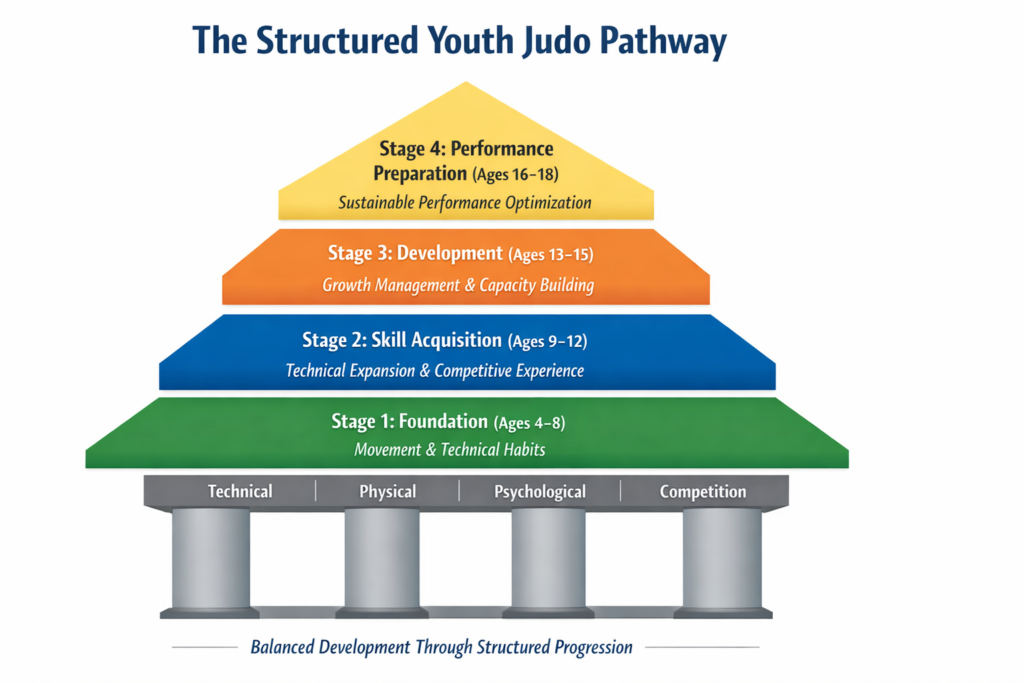
This diagram shows how development priorities shift from technique in early years to performance optimization in later stages.
The 4 Stages of a Long-Term Youth Judo Pathway
Stage 1 – Foundation Phase (Ages 4–8)for Youth Judo Training
Primary Focus: Movement literacy, safety, and fundamental technical habits
At this stage, the objective is not competitive performance.
It is building the physical and technical foundation that supports all future development.
Key Objectives:
- Master all forms of ukemi (forward, backward, side, rolling)
- Develop coordination, balance, and spatial awareness
- Learn correct fundamental gripping posture
- Learn correct throwing mechanics in basic forms
- Encourage bilateral movement (left and right)
- Use play-based learning to build engagement
- Avoid ranking pressure and performance comparison
Stage 1 focuses heavily on core judo fundamentals.
Stage 2 – Skill Acquisition Phase (Ages 9–12)for Youth Judo Training
Focus: Technical diversity.
Key objectives:
- Teach a wide range of throws
- Develop left and right side ability
- Introduce controlled randori
- Begin small competitions with low pressure
This is the most important technical window.
Over-specialization here creates future limitations.
H3: Talent Outliers vs Long-Term Developers
In every generation, there are athletes who dominate early and later become world-class competitors.
These athletes exist.
However, they are statistical outliers — not developmental norms.
Most young champions do not remain dominant at senior level.
A youth development framework must be built for the majority, not the exception.
H3: Competition as Experience, Not Identity
During Stage 2, competition should serve as:
- A learning environment
- A feedback mechanism
- A confidence-building tool
It should not define the athlete’s identity.
Winning is valuable.
But development remains the priority.
H3: National Competition in Stage 2 – Opportunity, Not Obligation
In countries where U13 national championships exist, participation can be appropriate during Stage 2.
However, the objective must be clear:
- The goal is experience, not identity.
- The goal is development under pressure.
- The goal is tactical learning.
Winning at U13 does not predict senior success.
But competing at U13 can accelerate growth — if properly managed.
Proper design requires age-appropriate judo training.
Stage 3 – Development Phase (Ages 13–15)for Youth Judo Training
Primary Focus: Managing growth, building strength, and stabilizing identity without compromising long-term potential.
This is the most fragile stage in youth judo development.
Adolescents experience:
- Rapid growth spurts
- Hormonal changes
- Temporary coordination loss
- Increased competitive exposure
- External pressure (ranking, selection, expectations)
Many athletes are lost at this stage — not because of lack of talent, but because of poor management.
H3: Growth Comes Before Performance
During Stage 3, the body is changing faster than technique can adapt.
Coaches must:
- Adjust training intensity during growth spurts
- Monitor coordination changes
- Reduce volume when movement quality drops
- Protect joint health
The objective is not to peak.
The objective is to stabilize development.
H3: Strength Development Without Aggressive Weight Control
This is an appropriate stage to introduce structured strength training.
However:
- No aggressive weight cutting
- No rapid dehydration
- No chronic calorie restriction
- No pressure to stay artificially small
Adolescence is a time to build capacity — not manipulate body weight.
Weight class decisions should follow natural growth trends, not short-term competitive advantage.
H3: Competition as Structured Exposure
National and international cadet-level events may begin during this stage.
Participation is acceptable — but must be guided.
Competition should:
- Reinforce technical development
- Build tactical awareness
- Strengthen psychological resilience
It should not:
- Define identity
- Justify unsafe weight practices
- Replace skill progression with result obsession
Winning at 14 does not predict winning at 24.
H3: Technical Refinement Over Specialization
While athletes may have preferred techniques, technical diversity must remain.
This stage should emphasize:
- Refining movement efficiency
- Improving kuzushi quality
- Strengthening transition skills
- Expanding tactical combinations
Specialization should evolve gradually — not be forced.
H3: Psychological Stability and Identity Formation
Stage 3 is when athletes begin to define themselves.
Danger appears when identity becomes:
“I am my ranking.”
“I am my weight class.”
“I am my medals.”
The framework must protect identity by reinforcing:
Process over pressure
Effort over outcome
Learning over ranking
Stage 4 – Performance Preparation Phase (Ages 16–18)for Youth Judo Training
Primary Focus: Performance refinement aligned with biological maturity and long-term sustainability.
This stage marks the transition from youth to junior-level competition.
Athletes now face:
- Increased training intensity
- International exposure
- Ranking systems
- Weight class decisions that affect long-term trajectory
However, performance must still align with development.
H3: Transition From Cadet to Junior – A Critical Decision Point
The move from cadet to junior level is often accompanied by a change in physical maturity.
Some athletes struggle to maintain their cadet weight class without aggressive restriction.
Others remain naturally stable in their category.
This transition must be evaluated individually.
H3: Weight Class Decisions Based on Biological Reality
During Stage 4:
- If maintaining a weight class requires excessive restriction, the athlete should move up.
- If the athlete can compete at a weight class without aggressive cutting or performance decline, continuation may be appropriate.
The key principle:
Weight class must follow natural development — not nostalgia for past success.
An athlete should never shrink to stay competitive.
H3: Introducing Structured Weight Management (If Appropriate)
Unlike Stage 3, moderate and well-supervised weight management may be introduced at this stage.
However:
- No extreme dehydration
- No chronic under-eating
- No emotional attachment to a number
Weight adjustments must support performance — not undermine health.
H3: Performance Optimization Without Identity Fixation
At this stage, athletes may:
- Target national junior titles
- Compete internationally
- Aim for world-level qualification
But development principles remain:
- Technical efficiency before volume
- Recovery prioritization
- Strength and power integration
- Psychological resilience
Performance becomes important — but sustainability remains central.
H3: Long-Term Projection Over Short-Term Medals
The final question at Stage 4 is not:
“Can this athlete win now?”
It is:
“Will this athlete still be improving at 22?”
If maintaining a weight class compromises:
- Strength gain
- Hormonal health
- Recovery capacity
- Mental stability
Then the long-term pathway is at risk.
Technical Progression Inside the Framework
Technical teaching should follow progression principles:
- Teach variability before specialization
- Teach balance before power
- Teach control before aggression
Advanced techniques should not be rushed.
Specialization should emerge naturally after broad exposure.
Randori frequency must increase gradually, not abruptly.
Physical Development Integration
Strength training should not begin based on age alone.
It should align with biological maturity.
Important considerations:
- Monitor growth spurts
- Reduce load during coordination loss
- Introduce bodyweight strength first
- Educate about recovery and sleep
ACL risk increases during adolescence, particularly in female athletes. Proper landing mechanics and hip strength are essential.
Competition Planning Within the Framework
Competition is a tool — not the objective.
Key principles:
- Limit early competition volume
- Avoid weight cutting in youth
- Use tournaments as feedback, not validation
- Separate ranking from identity
Excessive medal focus creates fragile athletes.
Long-term competitors outperform early champions.
Common Mistakes in Youth Judo Systems
- Early specialization
- Medal-driven culture
- Overtraining during puberty
- Ignoring psychological development
- Copying senior training models
Youth judo requires its own design.
Many systems fail due to common youth judo training mistakes.
Example: 10-Year Development Roadmap
Age 6–8
→ Movement mastery, ukemi, enjoyment
Age 9–12
→ Technical expansion, bilateral development
Age 13–15
→ Strength introduction, growth management
Age 16–18
→ Tactical refinement, competition structure
Each phase builds upon the previous one.
Skipping stages creates instability.
Conclusion: Development Before Medals
A youth judo development framework protects potential.
Medals are outcomes.
Development is the process.
When we design long-term pathways, we do not just create champions — we create resilient, sustainable athletes.
The future of judo depends on how we develop the young.
This aligns with long-term athlete development in judo.
If you are looking for kids judo classes on the Gold Coast,
Hirose Judo Academy offers structured training focused on
long-term athlete development.
Learn more about our Kids Judo Classes on the Gold Coast.