
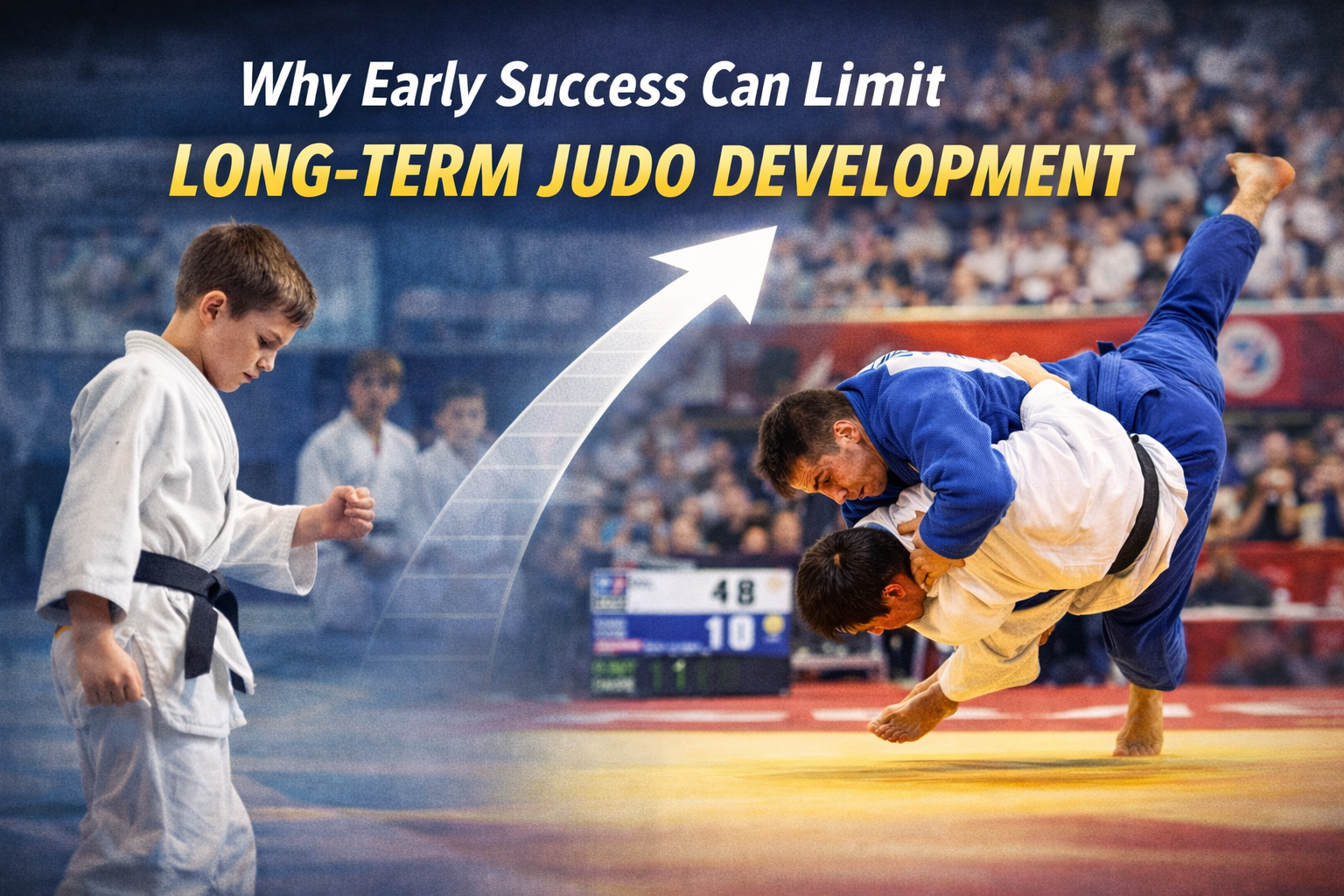
Early success in youth judo often feels like proof that everything is going well.
Athletes win matches, parents feel reassured, and coaches gain confidence in their methods.
However, early results do not always reflect true long-term potential.
In many cases, they can hide deeper problems in athlete development.
To understand the broader context of long-term athlete development, see:
“From Youth Development to World-Level Performance“
Early success feels positive — but it can be misleading
Winning at a young age is not inherently bad.
The problem arises when early success is mistaken for correct development.
In youth categories, results are often influenced by factors unrelated to future performance:
- physical size
- early puberty
- temporary strength advantages
When success comes mainly from these factors, technical growth and decision-making are often overlooked.
Physical maturity is often mistaken for talent
In judo, early-maturing athletes frequently dominate their peers.
They appear strong, confident, and successful.
But physical maturity is temporary.
As other athletes catch up physically, those who relied on strength alone often struggle.
At that stage, the absence of solid fundamentals becomes clear.
True talent in judo is not only about winning early —
it is about learning, adapting, and improving over time.
The hidden cost of “winning too early”
An excessive focus on early victories can create long-term risks:
- Overuse injuries from repetitive, result-driven training
- Burnout caused by constant pressure to win
- Reduced creativity and problem-solving ability
- Dependence on physical advantages instead of technique
In some cases, athletes stop enjoying the sport altogether.
When winning becomes the only goal, development quietly stops.
What truly supports long-term judo development
Sustainable athlete development is built on a different foundation:
- consistent fundamentals
- safe and progressive training loads
- patience from coaches and parents
- an environment that values learning over immediate results
Competition is important, but timing matters.
Athletes need the right challenges at the right stage of development.
A long-term pathway matters more than early medals
Medals won at a young age rarely determine success at the international senior level.
What matters more is whether the athlete continues to grow:
- technically
- physically
- mentally
The goal is not to win early —
the goal is to still be improving years later.
If you want to go further into how to train the fundamentals that lead to long-term success, see:
“The Fundamentals That Build World-Level Judoka“
Conclusion
Early success can feel reassuring, but it should never be the final measure of development.
In judo, the athletes who reach the highest level are often not the ones who won the most as children,
but the ones who were allowed to develop patiently, correctly, and consistently.
Long-term development requires discipline, restraint, and trust in the process.
For a complete structured pathway, read our youth judo development framework.
If you are looking for kids judo classes on the Gold Coast,
Hirose Judo Academy offers structured training focused on
long-term athlete development.
Learn more about our Kids Judo Classes on the Gold Coast.