
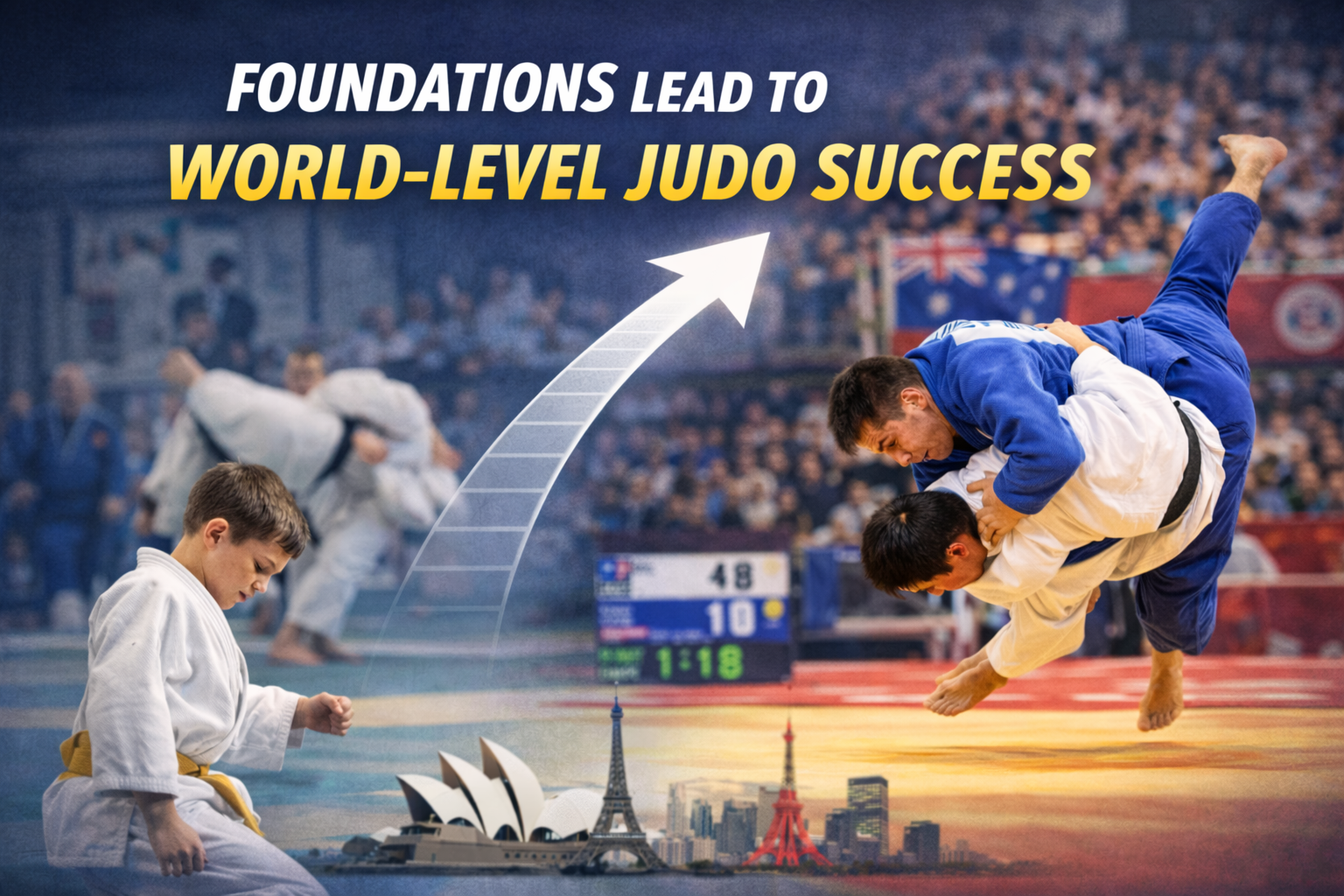
Why “Fundamentals” Are Often Misunderstood
In many youth development environments, priority is often given to techniques that score quickly in competition. This approach is understandable — winning brings confidence, recognition, and short-term success.
However, this often leads to a hidden problem.
Young athletes start relying heavily on simple, one-handed techniques or movements that work mainly because of speed, strength, or physical advantage. These techniques can produce early results, especially against peers of similar age.
But early success can create a false sense of development.
At the world level, matches are not decided by quick tricks or easy entries. They are decided by the quality of an athlete’s foundation — their ability to control balance, apply force correctly, and execute techniques under pressure against equally strong opponents.
Another misunderstanding is that young athletes often think “fundamentals = easy.”
In reality, fundamentals are not easy — they are simply less flashy.
This article expands on the long-term development philosophy first discussed in:
“From Youth Development to World-Level Performance“
The Real Fundamentals That Connect to World-Level Judo
Many basic elements such as ukemi (breakfalls) and general movement patterns are usually taught well. Young athletes often learn how to fall safely and move on the mat effectively.
But true world-level fundamentals go further.
• Weight Transfer (Batsujuu / Unweighting Skills)
In high-level judo, athletes must react instantly when an opponent attacks — lowering the hips, adjusting balance, and controlling body weight distribution.
These skills are not always developed through standard drills alone. Specific exercises that teach removing and shifting weight efficiently are essential. This is a key bridge between basic movement and advanced performance.
• Technique Before Grip Fighting
Grip fighting (kumi-kata) is important — but it is not the foundation for young athletes.
Grip strategies can be developed later.
What must be built early is the ability to throw with full commitment using two hands and proper technique.
When young athletes rely too much on grips or one-sided control, they may win early — but their throwing ability stops developing. Strong or fast children often succeed with grip-based control, but this creates a ceiling.
Throwing skills, on the other hand, create long-term growth.
・Ne-waza (Ground Techniques) as a Major Equalizer
Many development systems focus almost entirely on standing techniques. However, groundwork is one of the most powerful long-term assets an athlete can build.
Standing judo is influenced by timing, coordination, and natural physical attributes.
Groundwork is different — effort translates directly into improvement. The more an athlete trains ne-waza, the stronger they become, regardless of natural talent.
Ground skills create resilience, tactical depth, and scoring opportunities that often decide high-level matches.
To understand one of the risks that arises when fundamentals are overlooked, see:
“Why Early Success Can Limit Long-Term Judo Development“
Why These Fundamentals Are Often Overlooked
These skills are frequently neglected because:
- They do not produce immediate victories
- They look repetitive and less exciting
- They require patience from both coach and athlete
- Progress is slower and less visible
In competition-focused environments, short-term results often overshadow long-term development.
What Makes Athletes Who Keep Improving Different
Athletes who continue improving year after year usually share common traits:
- They build their judo around core techniques, not shortcuts
- They are comfortable doing repetitive technical work
- They develop both standing and groundwork skills
- They trust the process even when progress feels slow
These athletes may not always dominate early, but they rarely stop progressing.
Fundamentals Are “Unflashy” — But They Shape the Future
Fundamentals do not draw attention on social media.
They do not always win youth tournaments.
They do not look impressive in short clips.
But they determine:
- Who plateaus
- Who adapts at higher levels
- Who survives physically demanding matches
- Who reaches international standards
The difference at the top is rarely talent alone — it is almost always foundation.
Conclusion
Fundamentals are not the starting point of development.
They are the structure that carries an athlete through every stage of their career.
Quick success built on easy techniques may create early results.
But long-term success is built on:
- sound movement
- weight control
- true throwing ability
- and strong groundwork
These elements may look simple — but they are what build world-level judoka.
For a complete structured pathway, read our youth judo development framework.
If you are looking for kids judo classes on the Gold Coast,
Hirose Judo Academy offers structured training focused on
long-term athlete development.
Learn more about our Kids Judo Classes on the Gold Coast.