
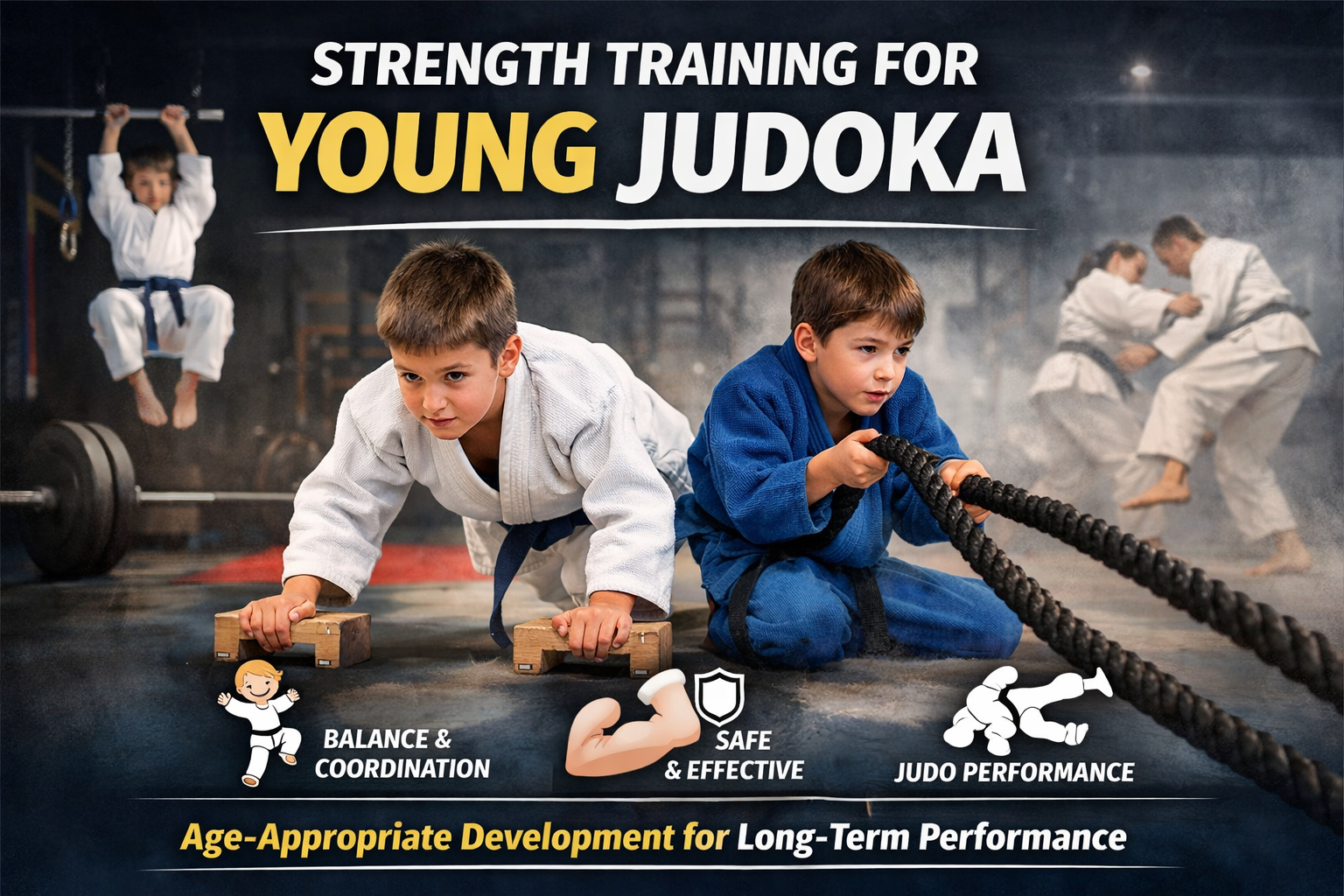
Strength training for young judoka is often misunderstood.
Many coaches and parents associate strength with lifting heavier weights or building muscle early. However, in youth judo, strength development is not about creating stronger children — it is about building athletes who can safely improve for many years.
When strength training is introduced incorrectly, young athletes may experience injury, burnout, or technical stagnation. When developed appropriately, strength becomes the foundation that allows technique, confidence, and performance to grow naturally over time.
This article explains how strength should be developed in young judoka using a long-term athlete development approach.
Strength development should always follow sound youth judo development principles.
Why Strength Training Matters in Youth Judo
Judo is not only a technical sport. Even at young ages, athletes must:
- maintain posture under pressure
- control balance during movement
- absorb impact safely through ukemi
- stabilize joints during throwing actions
- repeat efforts during randori
Without adequate physical preparation, technical learning becomes limited.
Proper strength development helps young judoka:
✅ reduce injury risk
✅ improve movement efficiency
✅ maintain technical posture
✅ tolerate training load
✅ develop confidence on the mat
Importantly, strength supports technique — it should never replace it.
The Biggest Mistake: Training Young Judoka Like Adults
One of the most common coaching errors is applying adult strength programs to children.
Typical mistakes include:
- early heavy weightlifting
- maximal strength testing
- conditioning focused on fatigue
- competition-driven physical training
- prioritizing power before coordination
Young athletes are still developing neurologically and structurally. Their bodies respond best to movement quality, not external load.
Early specialization in strength often leads to:
- poor movement patterns
- overuse injuries
- reduced long-term potential
- emotional exhaustion
Youth training should prepare athletes for future performance — not immediate results.
What “Strength” Really Means for Young Judoka
For developing athletes, strength is not muscle size.
In youth judo, strength primarily means:
- posture control
- coordination
- balance under movement
- joint stability
- force transmission through the body
A young judoka who can maintain posture while moving, gripping, and falling safely is already demonstrating functional strength.
Before resistance is added, athletes must first learn how to control their own body.
Movement competence always comes before load.
True strength begins with mastering fundamental movement skills in judo.
Age-Appropriate Strength Development Model
Ages 6–9: Movement Foundation Stage
At this stage, the goal is movement literacy.
Recommended focus:
- crawling and animal movements
- climbing and hanging
- rolling and ukemi variations
- balance challenges
- playful resistance games
Training should feel like exploration rather than exercise.
Children develop coordination, spatial awareness, and body control — the true base of future strength.
Ages 10–12: Bodyweight Strength Development
Athletes begin improving control and endurance.
Focus areas include:
- bodyweight pulling and pushing
- core stability exercises
- unilateral balance work
- grip endurance through games
- controlled partner drills
External weight remains minimal. Technical precision is more important than intensity.
Ages 13–15: Introduction to Structured Resistance
During early adolescence, resistance training can be introduced carefully.
Key principles:
- technique before load
- supervised instruction
- gradual progression
- emphasis on movement quality
Appropriate exercises may include:
- light resistance training
- medicine ball throws
- controlled strength circuits
- injury-prevention exercises
The objective is education, not maximal strength.
Best Strength Exercises for Young Judoka
Effective youth strength training often looks different from traditional gym workouts.
Examples include:
- animal walks for total-body coordination
- partner resistance movement drills
- static core stabilization holds
- pulling and hanging exercises
- groundwork strength games
- balance-based throwing entries
These exercises directly transfer to judo performance while maintaining safety.
When Should Young Judoka Start Weight Training?
There is no universal age.
Instead, readiness depends on whether the athlete can:
- control bodyweight movements correctly
- maintain posture consistently
- follow technical instruction
- demonstrate training maturity
Weight training should begin only after movement competence is established.
Supervision and progressive loading are essential.
Strength Development and Injury Prevention
Many youth injuries occur not because training is too hard, but because athletes lack foundational strength.
Proper development helps protect:
- knees during direction changes
- shoulders during gripping exchanges
- hips and spine during throwing
- joints during growth periods
Strength training aimed at stability and control significantly reduces injury risk and supports long-term participation.
Proper strength development plays a critical role in injury prevention in youth judo.
Long-Term Strength Development in Judo
The goal of youth strength training is not early dominance.
It is sustainability.
Athletes developed patiently often show:
- fewer injuries
- better technical adaptation
- emotional stability in competition
- continuous improvement across years
In long-term athlete development, strength evolves progressively alongside technique, coordination, and tactical understanding.
Great senior judoka are rarely built quickly — they are built consistently.
Conclusion
Strength training for young judoka should never be rushed.
The strongest young athletes are not those who lift the most weight, but those who move efficiently, control their bodies, and remain healthy throughout development.
By prioritizing age-appropriate training, coaches and parents can help young judoka build a foundation that supports performance not only today, but throughout their entire athletic career.
Long-term success in judo begins with intelligent development — not early intensity.
Strength development must align with long-term athlete development in judo.
If you are looking for kids judo classes on the Gold Coast,
Hirose Judo Academy offers structured training focused on
long-term athlete development.
Learn more about our Kids Judo Classes on the Gold Coast.