
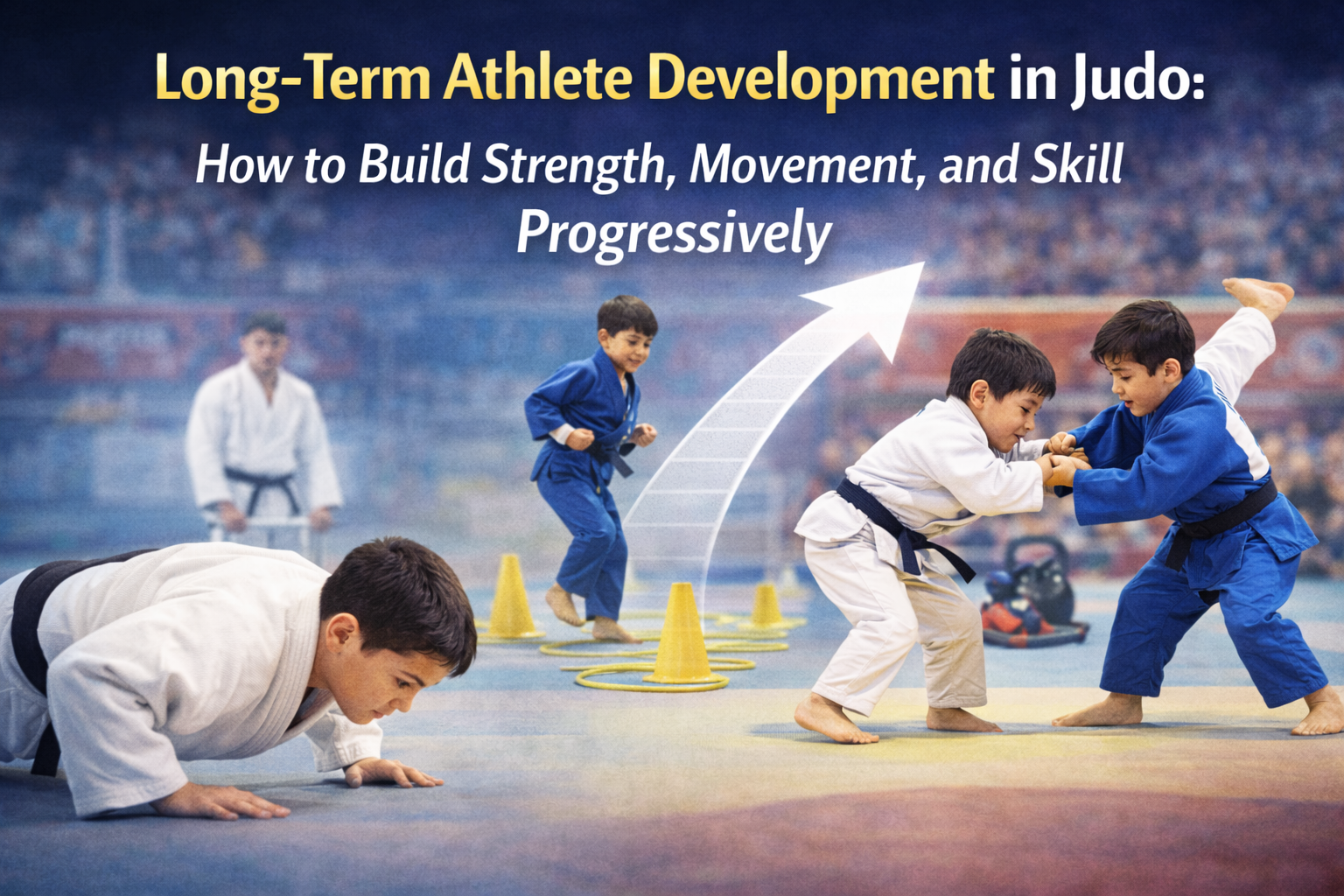
Modern judo development often focuses on what is visible — medals, competition results, and early success. But long-term performance is built on what is less visible
Athletes who reach senior international level are not simply talented. They are built through a structured process that develops their body and technical ability step by step over many years.
This is where long-term athlete development becomes essential.
To understand why traditional competitive success can sometimes hinder deeper growth in youth judo,”Why Early Success Can Limit Long-Term Judo Development”
Why Physical Development Matters in Long-Term Judo
Judo is not only technical. It is a sport of balance, coordination, strength, timing, and spatial awareness. Without physical preparation that supports technique, progress eventually stops.
Young athletes may win using speed or strength, but if their physical development does not evolve alongside their technique, they will struggle later when opponents become equally strong.
Physical development is not separate from judo — it is what allows technique to grow.
Age-Appropriate Conditioning for Youth Judoka
Youth training should not copy adult training.
The goal in early years is to build:
- coordination
- balance
- body control
- mobility
- general strength through bodyweight movement
This stage is about teaching the body how to move efficiently, not building maximum power.
A young athlete who learns how to control their body develops faster technically because they can feel and adjust movement more precisely.
Strength Development That Supports Technique
Strength training in youth judo must support skill, not replace it.
If strength allows an athlete to overpower opponents without proper technique, learning slows. But when strength is built gradually and functionally, it enhances:
- stability in throws
- control during transitions
- resistance against opponent pressure
- injury prevention
The goal is not to create strong athletes quickly. The goal is to create athletes whose strength grows together with their technique.
Movement Quality Is the Foundation of Technical Growth
Before techniques become refined, movement must be efficient.
Athletes who learn how to:
- lower their center of gravity quickly
- adjust balance under pressure
- move fluidly between directions
- control posture and body positioning
can later learn advanced techniques more easily.
Movement training is often invisible work. It does not produce immediate competition results, but it determines long-term potential.
Skill Progression Must Match Physical Development
Technical training should evolve alongside physical growth.
Early stages focus on:
- correct fundamental throwing mechanics
- two-handed technical development
- safe falling and body awareness
- simple transitions to groundwork
As athletes mature physically, the complexity of technique increases.
Rushing complex techniques before the body is ready leads to compensation, bad habits, and limited long-term growth.
These practical training elements build on the foundational technical principles discussed in
“The Fundamentals That Build World-Level Judoka“
Sample Weekly Development Focus (Youth Level)
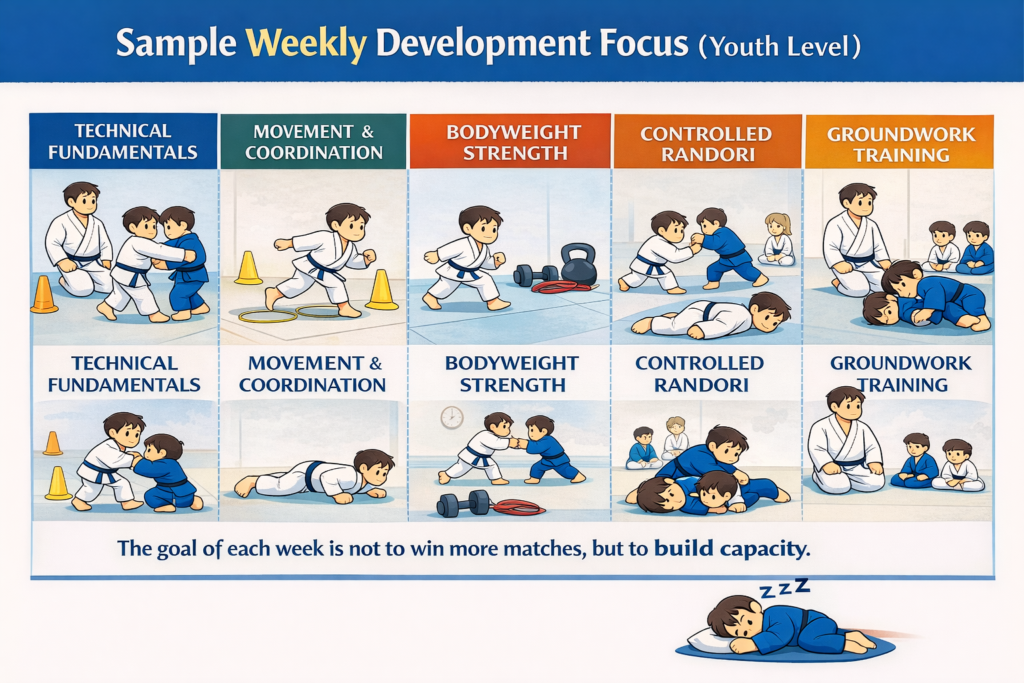
A balanced week for youth judoka might include:
- Technical sessions emphasizing fundamentals
- Movement drills for balance and coordination
- Bodyweight strength exercises
- Controlled randori focused on learning, not winning
- Groundwork training to develop control and problem-solving
The goal of each week is not to win more matches, but to build capacity.
Before we look at weekly focus, it’s useful to revisit why long-term progress matters and what it looks like:”From Youth Development to World-Level Performance“
Recovery, Consistency, and Patience
Long-term development depends on consistency over years, not intensity over weeks.
Adequate recovery, sleep, and injury prevention allow athletes to train regularly. Gaps in training slow development more than gradual progress.
Patience from coaches, parents, and athletes is one of the most important performance factors.
A System, Not a Season
Short-term preparation builds competitors.
Long-term systems build athletes.
When strength, movement, and skill are developed progressively, athletes reach senior level with a foundation that does not collapse under pressure.
This approach may not produce the most early champions, but it produces athletes who continue improving when others plateau.
For a complete structured pathway, read our youth judo development framework.
If you are looking for kids judo classes on the Gold Coast,
Hirose Judo Academy offers structured training focused on
long-term athlete development.
Learn more about our Kids Judo Classes on the Gold Coast.