
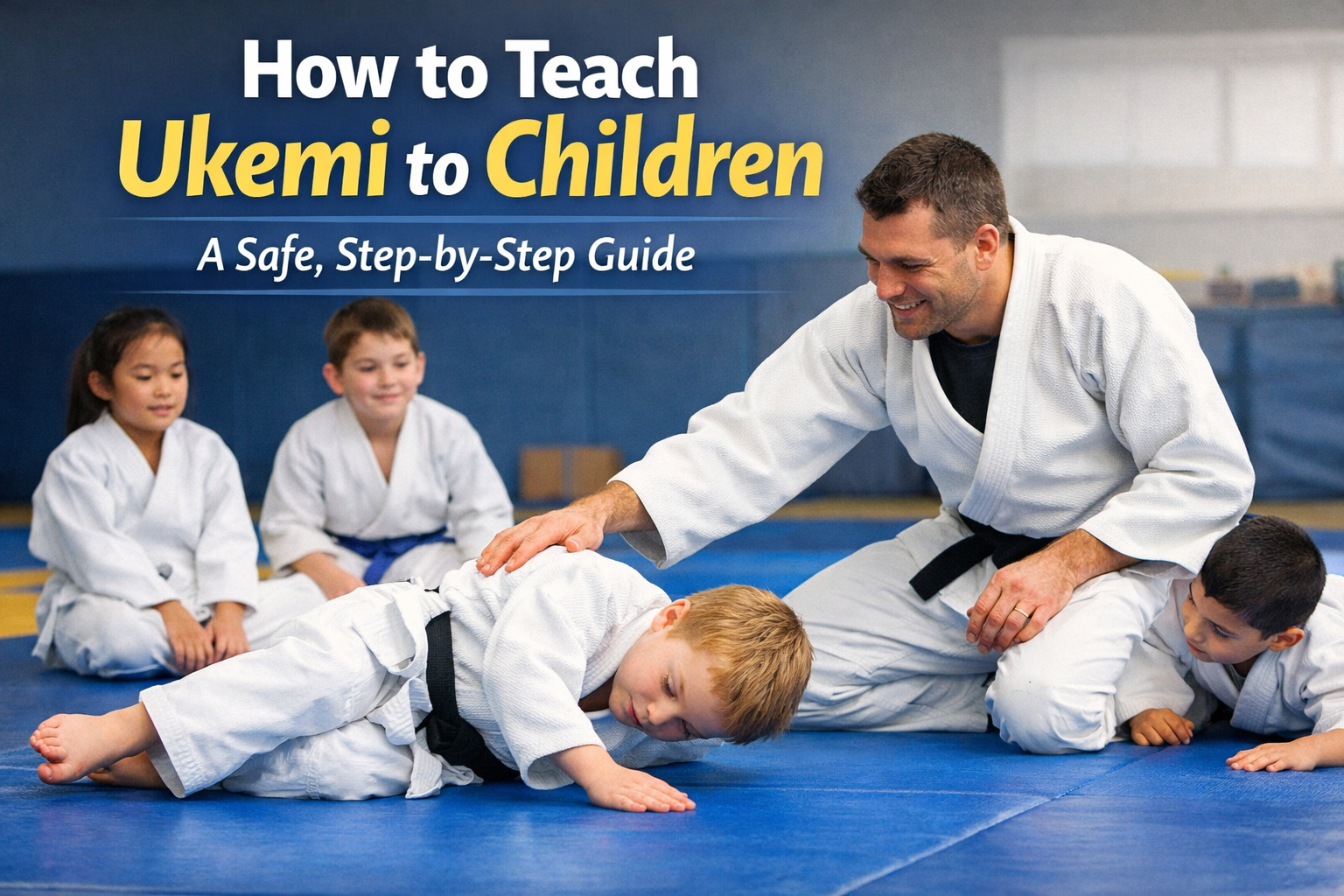
Ukemi is the first and most important skill in judo.
Before throws.
Before randori.
Before competition.
If children cannot fall safely, they cannot develop confidently.
Yet many coaches rush the process. They teach the movement before removing fear. They demand speed before teaching control. They focus on sound instead of safety.
This guide explains how to teach ukemi to children step by step — using a development-based approach that protects both body and confidence.
Ukemi plays a foundational role in youth judo development, especially in the early years of training.
Why Ukemi Is the First Skill Every Young Judoka Must Learn
Ukemi is not just a technique. It is a protective reflex.
For children, falling safely develops:
- Body awareness
- Spatial orientation
- Emotional control
- Impact tolerance
- Long-term injury prevention
In youth judo development, ukemi creates psychological safety. When children trust that they can fall without getting hurt, they become more willing to attack, explore, and learn.
Without that trust, progress slows.
As one of the core judo fundamentals, ukemi supports every future skill in training.
At What Age Should Children Start Learning Ukemi?
Children can begin learning falling patterns as early as 4–5 years old — but not in the traditional technical sense.
Ages 4–5: Movement Exploration
Focus on:
- Rolling games
- Soft backward rocking
- Animal movements
- Getting comfortable on the mat
At this stage, it is about comfort, not correction.
Ages 6–8: Basic Shape and Safety
Introduce:
- Backward ukemi from sitting
- Side ukemi from kneeling
- Tucking the chin
- Using arms to guide impact
Keep it slow. Avoid height.
Ages 9–12: Direction and Reaction
Now children can:
- Fall from standing
- Connect ukemi to light throws
- Practice reaction-based falling
This is where technical refinement begins.
Adolescents: Realistic Application
- Falling under pressure
- Dynamic direction changes
- Competition-specific situations
Progression must match nervous system development — not ego or competition schedule.
Step-by-Step: How to Teach Ukemi to Children
Step 1 – Remove Fear Before Teaching Technique
Fear blocks learning.
Start with:
- Sitting backward rocking
- Partner-supported falls
- Falling onto crash mats
- Play-based falling games
If a child is afraid, slow down. Forcing ukemi creates tension, and tension increases injury risk.
Step 2 – Teach Shape, Not Speed
Many coaches focus on loud arm slaps. This is a mistake.
Instead, focus on:
- Chin tucked
- Rounded back
- Arms at 45 degrees
- Relaxed exhale on impact
Shape creates safety. Speed comes later.
Step 3 – Control Direction
Introduce clear patterns:
- Ushiro ukemi (backward)
- Yoko ukemi (side)
- Mae ukemi (forward roll)
Teach from:
- Sitting
- Squatting
- Kneeling
- Low standing
Never jump levels too quickly.
Step 4 – Add Reaction-Based Ukemi
Real falling is unpredictable.
Progress to:
- Light push-and-fall drills
- Controlled off-balancing
- Game-based reaction exercises
This improves reflexes and reduces hesitation during throws.
Common Mistakes When Teaching Ukemi to Children
- Teaching from standing too early
- Demanding loud slaps
- Ignoring fear signals
- Rushing toward throwing practice
- Correcting too much
Children learn ukemi through repetition and confidence — not pressure.
How to Teach Ukemi to Children Who Are Afraid of Falling
Fear of falling is normal.
Do not shame it. Do not rush it.
Instead:
- Lower the height
- Use hands for support
- Demonstrate slowly
- Celebrate small success
Confidence builds layer by layer.
Some children need weeks before they fall comfortably from standing. That is normal.
How Often Should Children Practice Ukemi?
Short answer: every session.
But not as punishment.
Ukemi can be:
- Warm-up activity
- Movement drill
- Reaction game
- Part of throwing combinations
Five minutes every session is more effective than one long session per week.
Consistency builds automatic response.
Ukemi and Long-Term Athlete Development
Ukemi trains:
- Core control
- Neck stability
- Eccentric strength
- Spatial awareness
These qualities contribute to injury prevention and long-term performance.
In high-level development environments, strong ukemi often separates resilient athletes from fragile ones.
Ukemi is not just about falling safely today.
It is about protecting the athlete’s future.
This aligns with long-term athlete development principles in judo.
Frequently Asked Questions About Teaching Ukemi to Children
How long does it take for children to learn ukemi?
It depends on age, confidence, and training frequency.
- Ages 4–6: Several weeks just to feel comfortable falling.
- Ages 7–10: 4–8 weeks to develop basic consistency.
- Ages 11+: Often faster, but emotional hesitation can still exist.
The goal is not speed.
The goal is automatic safety response.
Some children progress quickly. Others need more repetition. Both are normal.
Should children learn all types of ukemi at once?
No.
Start with backward ukemi (ushiro ukemi) because it is the most protective and commonly needed.
Then progress to:
- Side ukemi (yoko ukemi)
- Forward rolling ukemi (mae ukemi)
Teaching all directions too early can overwhelm young children.
Master one pattern before layering complexity.
Is it safe to teach ukemi to 4 or 5 year olds?
Yes — if you teach it as movement play, not technical falling.
At this age:
- No standing falls
- No speed
- No correction-heavy coaching
- Focus on rolling and rocking
Safety depends on progression, not age alone.
Why do some children slap the mat too hard?
Because they are copying adults.
The purpose of the arm movement is to guide impact and increase surface area — not to create noise.
Excessive force in the slap can:
- Increase elbow stress
- Create shoulder tension
- Reinforce poor relaxation habits
Teach control, not volume.
How can I help a child who keeps lifting their head when falling?
This is very common.
Try:
- Placing a soft object under their chin and asking them to “hide it”
- Slow backward rocking drills
- Having them look at their belt while falling
Verbal correction alone rarely works.
Use simple physical cues.
Should ukemi be practiced every training session?
Yes — but briefly.
3–5 minutes at the start of each class is ideal.
Ukemi should feel routine, not dramatic.
When practiced consistently, it becomes automatic.
Can poor ukemi increase injury risk later?
Yes.
Children who do not develop relaxed falling patterns may:
- Resist throws
- Stiffen during impact
- Land on extended arms
- Avoid attack situations
Over time, this increases risk of shoulder, elbow, and neck injuries.
Good ukemi supports long-term durability.
Proper falling mechanics also play a role in injury prevention, especially during growth phases.
Final Thoughts
If you are wondering how to teach ukemi to children, remember this:
Start with comfort.
Teach shape before speed.
Progress gradually.
Protect confidence.
Ukemi is not simply the first technique of judo.
It is the foundation of long-term development.
If you are looking for kids judo classes on the Gold Coast,
Hirose Judo Academy offers structured training focused on
long-term athlete development.
Learn more about our Kids Judo Classes on the Gold Coast.