
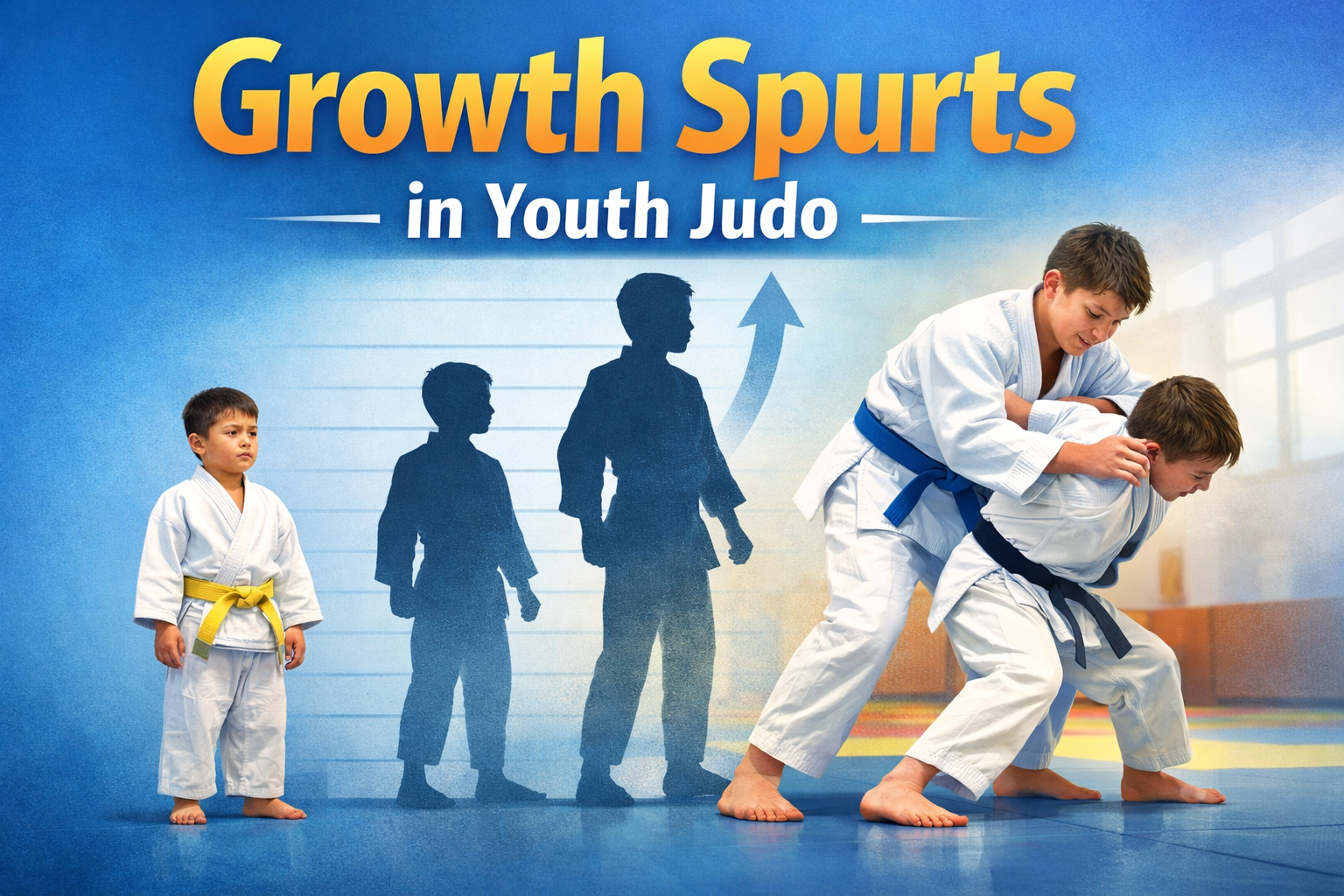
Youth judo coaches and parents often notice a confusing pattern.
A young judoka who previously showed excellent balance, timing, and coordination suddenly begins to struggle with techniques.
Throws that once felt natural may suddenly feel awkward. Footwork may become less precise, and randori performance may temporarily decline.
In many cases, the explanation is simple:
The athlete is experiencing a growth spurt.
During adolescence, rapid physical growth changes body proportions, limb length, and movement control. These changes can temporarily disrupt coordination and timing in sports that rely heavily on balance and body control, such as judo.
Sports scientists sometimes refer to this phenomenon as “adolescent awkwardness.”
Understanding how growth spurts affect coordination allows coaches to support young judoka effectively while protecting their long-term development.
Understanding how growth spurts influence training is an important part of long-term athlete development in judo.
What Is a Growth Spurt in Young Athletes?
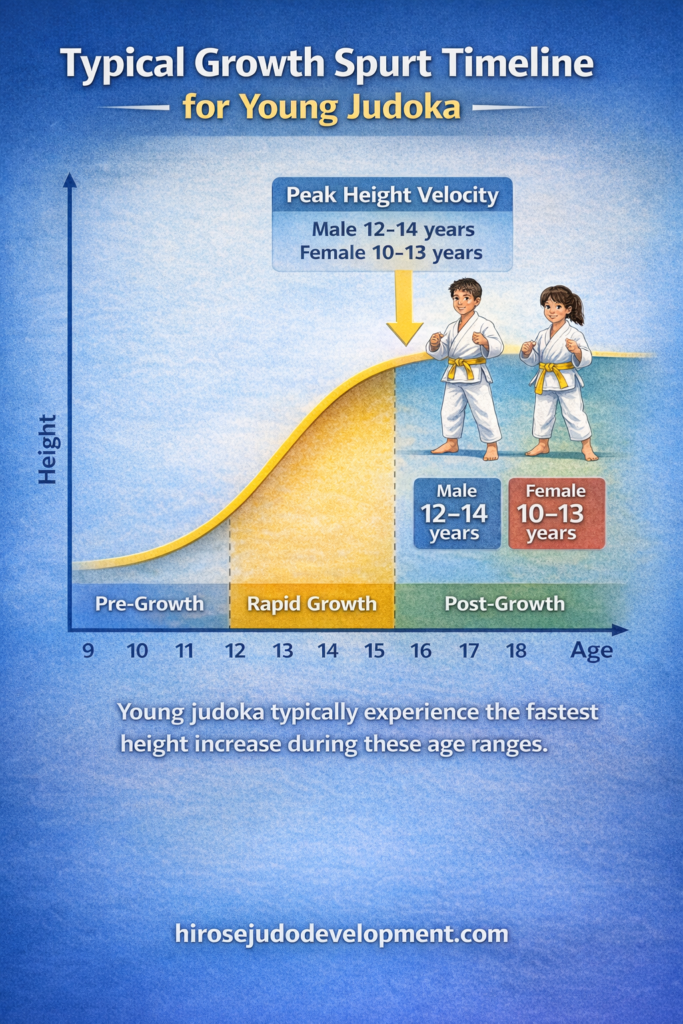
A growth spurt is a period of rapid physical growth during adolescence when height increases quickly over a relatively short period of time.
Typical age ranges include:
- Girls: 10–14 years old
- Boys: 12–16 years old
The fastest rate of height increase during puberty is known as Peak Height Velocity (PHV).
Figure: Typical Growth Spurt Timeline for Young Judoka
Because muscles and the nervous system need time to adapt, athletes may temporarily experience changes in coordination and movement control.
During this stage:
- Bones grow rapidly
- Limb length increases
- Body proportions change
However, muscles, tendons, and the nervous system often require additional time to adapt to these changes.
Because of this temporary mismatch, athletes may experience a short period where their movement coordination becomes less consistent.
How Growth Spurts Affect Judo Performance
Judo is a sport that relies heavily on:
- balance
- timing
- posture
- coordination
- spatial awareness
When the body suddenly grows, these skills must be recalibrated.
Young judoka may experience temporary challenges such as:
- mistimed entries during throws
- reduced stability during kuzushi
- awkward foot placement
- slower reaction timing
These changes do not mean the athlete has lost ability. Instead, the nervous system is adapting to a body that has rapidly changed in size and proportion.
Once the body adapts, coordination often returns — sometimes at an even higher level than before.
Adolescent Awkwardness in Sports
Sports scientists often describe this temporary loss of coordination as adolescent awkwardness.
Adolescent awkwardness occurs when rapid physical growth temporarily disrupts motor control.
As the body grows, several changes occur simultaneously:
- limb length increases
- the center of mass shifts
- joint leverage changes
- neuromuscular control must adapt
Because the nervous system learned movement patterns based on the athlete’s previous body proportions, rapid growth can temporarily make those patterns less efficient.
This can make athletes appear:
- clumsy
- slower
- less coordinated
However, this stage is typically temporary and represents a normal part of athletic development.
Figure: Why Coordination Changes During Growth Spurts
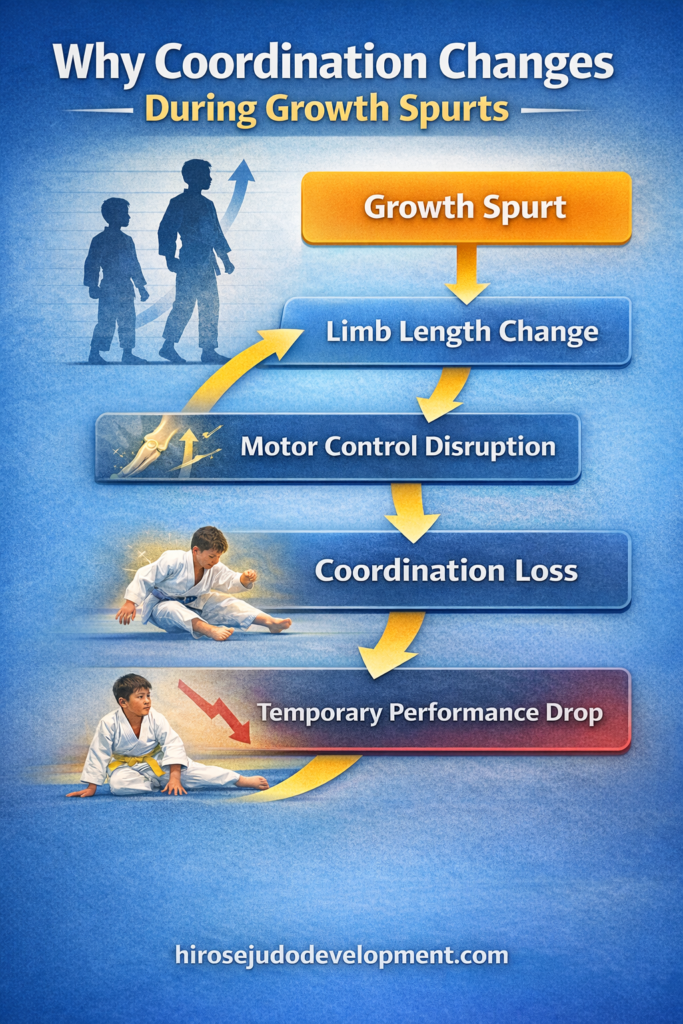
Rapid growth changes limb length and body proportions. This temporarily disrupts motor control, which can lead to coordination loss in young athletes.
Why Young Judoka Lose Coordination During Growth Spurts
Several biomechanical and neurological factors contribute to coordination loss during growth spurts.
Changes in Limb Length
As arms and legs grow longer, the body’s movement mechanics change.
Techniques that previously required a certain range of motion may now feel different because the athlete’s limbs are longer.
This requires the nervous system to rebuild motor patterns.
Changes in Center of Mass
Growth spurts also shift the body’s center of gravity.
In judo, balance and posture are critical for controlling both your own body and your opponent.
When the center of mass shifts, athletes must learn to stabilize their body in new ways.
This can temporarily affect:
- stance stability
- gripping exchanges
- throwing entries
Neuromuscular Recalibration
The nervous system must adapt to new body proportions.
This process is sometimes referred to as neuromuscular recalibration.
During this stage, movement patterns that once felt automatic may temporarily require conscious control again.
As the nervous system adapts, coordination gradually returns.
Developing strong fundamentals early helps young athletes adapt more easily to physical changes during adolescence.
Signs a Young Judoka Is Experiencing a Growth Spurt
Coaches can often recognize growth spurts through a combination of physical and performance changes.
Common signs include:
- sudden increase in height
- temporary loss of coordination
- awkward movement patterns
- difficulty controlling balance
- increased fatigue during training
- tight muscles
- knee discomfort
Recognizing these signs helps coaches adjust training expectations appropriately.
Injury Risks During Growth Spurts
Rapid growth can also increase the risk of certain injuries in young athletes.
This occurs because bones grow faster than muscles and tendons can adapt.
In judo, the most common areas of concern include the knees and lower body.
Knee Stress
The knee joint experiences significant stress during:
- explosive movement
- rapid direction changes
- throwing mechanics
When coordination temporarily decreases, this stress can increase.
Osgood-Schlatter Disease
Osgood-Schlatter disease is a common condition among young athletes during growth spurts.
It occurs when the patellar tendon places stress on the growth plate at the top of the tibia.
Symptoms may include:
- pain below the kneecap
- swelling around the tibial tuberosity
- discomfort during jumping or kneeling
Because judo training includes many kneeling positions and explosive movements, coaches should monitor knee health carefully during growth phases.
Safe falling skills are essential to reduce injury risk during training.
How Coaches Should Adapt Training
Growth spurts do not mean young athletes should stop training. However, coaches can make small adjustments that help athletes navigate this stage safely.
Emphasize Movement Quality
During growth spurts, training should focus on improving movement control rather than increasing intensity.
Helpful training methods include:
- coordination drills
- balance training
- controlled technical repetition
These activities help the nervous system adapt to new body proportions.
Manage Training Intensity
While athletes can continue practicing normally, it may be beneficial to slightly reduce the intensity or volume of randori during periods of rapid growth.
This allows athletes to continue developing technically while reducing injury risk.
Continue Technical Repetition
Fundamental techniques should remain part of training.
Examples include:
- uchikomi
- nagekomi
- grip transitions
Consistent technical repetition helps rebuild movement patterns as the body adapts.
Strength and Stability Training
Bodyweight strength training can improve joint stability and reduce injury risk.
Effective exercises include:
- core stability drills
- hip strength exercises
- single-leg balance training
These exercises support long-term athletic development while minimizing excessive physical stress.
Great youth coaches understand that development is not always linear.
Long-Term Development Perspective
Growth spurts can be frustrating for athletes who feel their performance has suddenly declined.
However, this stage is a normal part of development and often precedes significant improvements.
Athletes who receive patient coaching and structured training during this phase often develop stronger:
- coordination
- movement awareness
- adaptability
From a long-term athlete development perspective, this stage should be viewed not as a setback but as an important transition in the athlete’s growth.
Conclusion
Growth spurts are an unavoidable part of youth athletic development.
In judo, rapid physical growth can temporarily affect coordination, balance, and technical execution. This stage, sometimes referred to as adolescent awkwardness, occurs as the body and nervous system adapt to new proportions.
For coaches and parents, understanding this process is essential.
By maintaining patient coaching, focusing on movement quality, and adjusting training intensity when necessary, young judoka can successfully navigate growth spurts and continue progressing toward long-term performance.
In many cases, once the body adapts, athletes return stronger, more coordinated, and better prepared for future development.
FAQ
Do growth spurts affect coordination in judo?
Yes. During growth spurts, rapid changes in limb length and body proportions can temporarily disrupt coordination and balance.
Should young judoka train differently during growth spurts?
Training can continue, but coaches may reduce training intensity and emphasize coordination, balance, and technical repetition.
Are injuries more common during growth spurts?
Yes. Growth spurts can increase the risk of overuse injuries, particularly around the knees and growth plates.
If you are looking for kids judo classes on the Gold Coast,
Hirose Judo Academy offers structured training focused on
long-term athlete development.
Learn more about our Kids Judo Classes on the Gold Coast.