
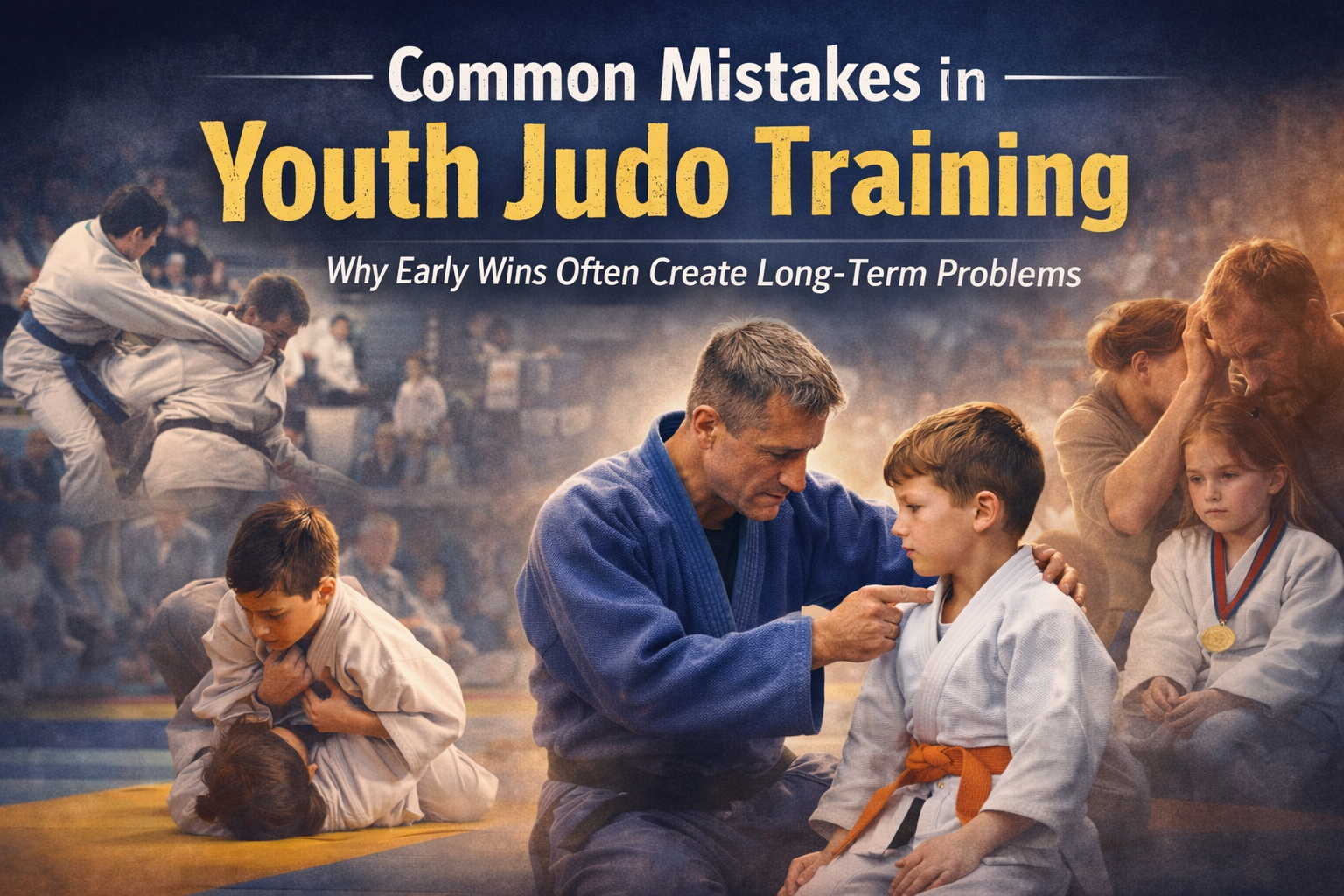
Youth judo training often looks successful from the outside.
Athletes win medals.
Coaches receive praise.
Parents feel reassured.
But many of these “successful” systems quietly fail.
Years later, those same athletes struggle to progress, lose motivation, or disappear entirely.
This article outlines the most common mistakes in youth judo training — not to criticize individuals, but to highlight structural problems that limit long-term development.
Mistake 1: Prioritizing Winning Over Learning
One of the biggest mistakes in youth judo is treating competition results as proof of development.
When winning becomes the main objective:
- Training narrows
- Risk-taking disappears
- Learning slows down
Young athletes are encouraged to use whatever works now — often strength, speed, or a single reliable tactic — instead of developing transferable skills.
Early victories can mask weak foundations.
Winning early does not predict senior success.
Learning capacity does.
(Related reading: internal link to Why Early Success Can Limit Long-Term Judo Development)
Mistake 2: Teaching Shortcut Techniques Too Early
Many youth programs rely heavily on:
- One-handed techniques
- Grip-dominant strategies
- Tactics designed to “steal” scores
These approaches are attractive because they produce fast results.
However, they come at a cost.
When children are not taught to:
- Control with both hands
- Enter properly
- Finish throws with balance
they never fully develop the feeling of throwing another human being — a skill that becomes extremely difficult to acquire later.
Some may argue this is “too strict” for children.
In reality, this is when such skills must be learned.
(Related reading: internal link to The Fundamentals That Build World-Level Judoka)
Mistake 3: Confusing Physical Advantage With Skill
Between the ages of 10–15, physical differences become obvious.
Some athletes grow earlier.
They become stronger, heavier, faster.
These athletes often dominate competitions — not because of superior technique, but because of physical advantage.
The mistake occurs when:
- Winning is interpreted as technical excellence
- Coaches stop correcting fundamentals
- Athletes stop being challenged
Eventually, physical gaps close.
When that happens, many “successful” athletes suddenly have nothing left to rely on.
(Related reading: internal link to Age-Appropriate Judo Development: What to Train and When)
Mistake 4: Neglecting Groundwork in Youth Training
Standing techniques dominate most youth programs.
Groundwork is often treated as:
- Secondary
- Optional
- Something to focus on “later”
This is a critical error.
Unlike standing judo, groundwork is:
- Less dependent on natural athleticism
- More equal across body types
- Highly trainable through repetition
Athletes who develop strong groundwork early gain:
- Tactical awareness
- Problem-solving ability
- Confidence in transitions
Groundwork is one of the most reliable tools for long-term success — yet one of the most ignored.
Mistake 5: Treating All Ages the Same
Youth judo is often trained as a simplified version of adult judo.
This ignores:
- Growth stages
- Neurological development
- Emotional maturity
What works for a 17-year-old does not work for a 9-year-old.
Without age-appropriate planning, training either becomes:
- Too easy to matter
- Or too hard to sustain
Development requires progression — not repetition.
Mistake 6: Early Specialization Disguised as “Commitment”
Training more is not the same as training better.
Some programs push young athletes into:
- Narrow technical profiles
- Fixed competition styles
- Constant pressure to perform
This is often described as “commitment” or “high standards.”
In reality, it limits adaptability.
Athletes who specialize too early struggle when:
- Rules change
- Opponents adapt
- Physical attributes shift
Long-term athletes remain flexible longer.
Mistake 7: Ignoring Invisible Progress
The most dangerous mistake may be expecting visible results too soon.
Real development often looks like:
- Slower progress
- Inconsistent competition results
- Temporary setbacks
Programs that cannot tolerate this phase usually abandon the process — just before it starts to work.
Foundations are invisible until they are tested.
(Related reading: internal link to Long-Term Athlete Development in Judo)
What Successful Programs Do Differently
Programs that consistently produce senior-level athletes share common traits:
- They value fundamentals over medals
- They delay specialization
- They allow athletes to struggle
- They build before they optimize
Most importantly, they define success by who remains competitive years later, not who wins first.
Conclusion
Youth judo does not fail because athletes lack talent.
It fails because systems mistake early success for development.
Avoiding these common mistakes does not guarantee medals tomorrow —
but it dramatically increases the chance of success when it truly matters.
Long-term judo development is not faster.
It is simply more honest.sa
For a complete structured pathway, read our youth judo development framework.
If you are looking for kids judo classes on the Gold Coast,
Hirose Judo Academy offers structured training focused on
long-term athlete development.
Learn more about our Kids Judo Classes on the Gold Coast.