
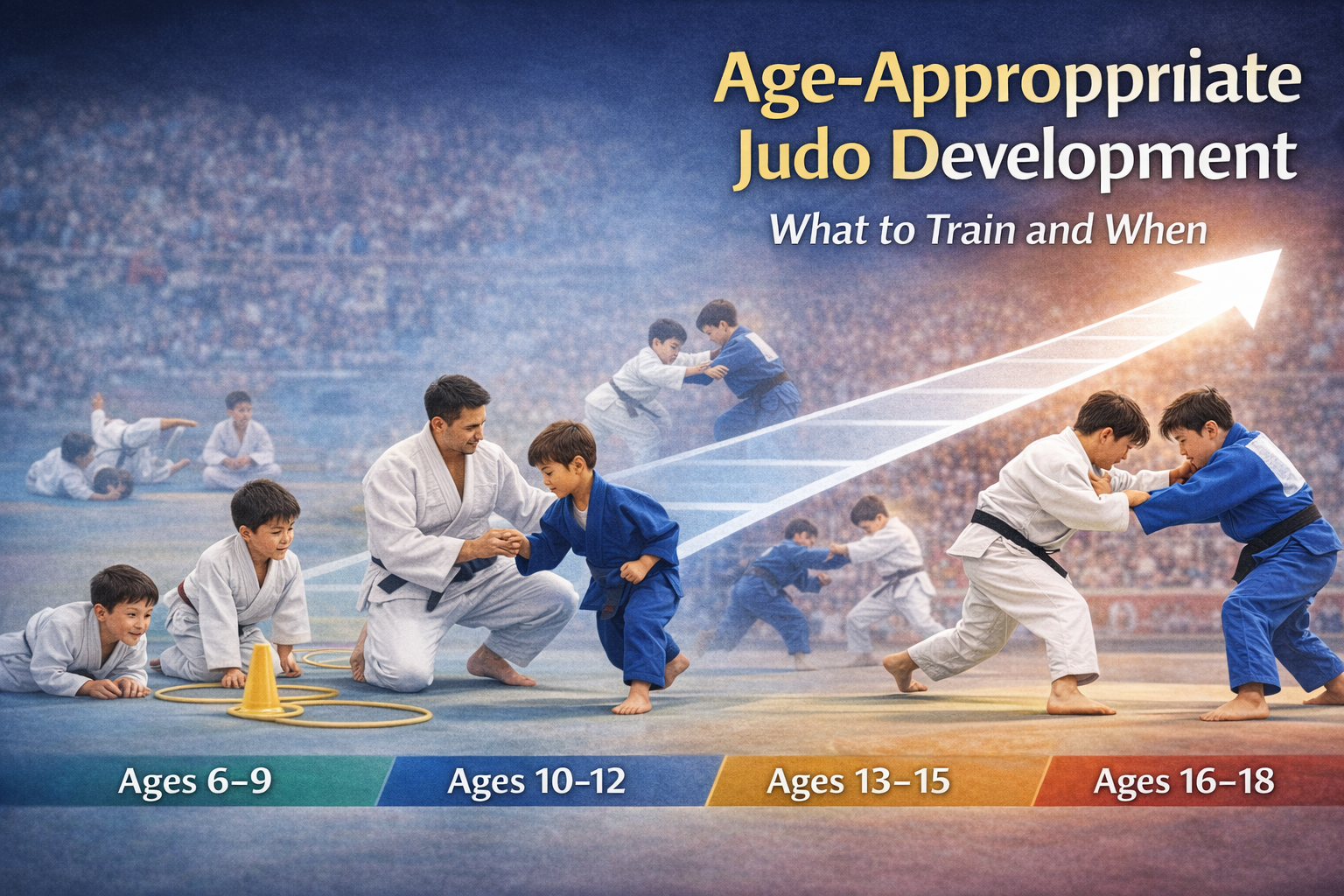
① Why Age Matters in Judo Development
Judo development is not only about what athletes train, but when they train it.
Many problems in youth judo do not come from a lack of effort or talent.
They come from doing the right things at the wrong time.
When training content ignores age and development stage, early results may appear — but long-term performance often suffers.
This is one of the core reasons why early success can limit future potential.
“Why Early Success Can Limit Long-Term Judo Development“
② Ages 6–9: Movement, Fun — and Correct Throwing Basics
Focus:
Movement, enjoyment, and correct fundamentals
At this age, children must enjoy judo — that is essential.
But enjoyment alone is not enough.
This period is the only time when athletes can naturally develop the feeling of throwing another person.
That feeling does not come later.
What must be included at this age:
- Ukemi (falling) and body awareness
- Basic movement: balance, stepping, turning
- Throwing practice using both hands (hikite and tsurite)
- Simple, controlled throwing repetitions
Children should learn to:
- Hold properly
- Enter correctly
- Throw with balance, not force
What should NOT be taught:
- One-handed techniques as a main method
- Shortcut techniques used only to win matches
If athletes are taught one-handed techniques too early, they often:
- Rely on speed or strength
- Avoid proper kuzushi
- Struggle to progress later
Fun is important — but structure matters.
Without early technical foundations, long-term growth becomes very difficult.
③ Ages 10–12: Learning Real Techniques Properly
Focus:
Technical correctness and repetition
This is the age where technique quality must deepen.
Key points:
- Two-handed gripping remains essential
- Clean entries and posture
- Repetition without rushing to win
- Groundwork introduced as a serious skill, not a break from standing
Athletes should not yet specialize or chase results.
This stage connects directly to the principles explained in:
The Fundamentals That Build World-Level Judoka
Also,At this stage:
- Physical differences become obvious
- Some athletes begin winning easily
This is where many systems fail.
Instead of building strength-based dominance, training should emphasize:
- Technique combinations
- Transitions between standing and groundwork
- Problem-solving under controlled pressure
Winning through physical advantage at this age often hides technical weakness.
④ Ages 13–15: Expanding Skills Without Early Specialization
At this stage, physical differences become very clear.
Some athletes grow earlier.
They become stronger, heavier, and faster than their peers.
As a result, early-maturing athletes tend to win more matches.
This is one of the most misleading phases in judo development.
Winning at this age often reflects biological timing, not superior judo.
Late-maturing athletes may struggle in competition, even if their technical understanding is higher.
That does not mean they are behind.
What matters most in this phase
For athletes who are not winning yet, this period is actually critical.
They must continue to:
- refine fundamental techniques
- learn to throw opponents properly, with balance and control
- rely on correct gripping with both hands
- develop timing, kuzushi, and finishing ability
Even if the results are not visible, this is where real judo is built.
Coaches and parents must resist the temptation to:
- simplify techniques just to win
- rely on strength-based gripping battles
- push early specialization because “it works now”
The danger of chasing results at 13–15
Athletes who win only because of size or strength often stop learning.
When physical advantages disappear later, they have nothing to fall back on.
Athletes who lose now—but keep building technique—gain something far more valuable:
a foundation that will survive adulthood and international competition.
At this age, not winning is sometimes part of correct development.
True long-term growth depends on patience, not early dominance.
⑤ Ages 16–18: Refining Style and Preparing for High-Level Competition
Focus:
Identity, durability, and international readiness
Now athletes can:
- Begin defining personal styles
- Increase physical training intensity
- Apply tactics responsibly
This is where earlier foundations show their value.
Athletes who were rushed earlier often struggle here.
Those who developed patiently become stable and adaptable.
This stage connects naturally to:
“From Youth Development to World-Level Performance“
⑥ The Biggest Mistake: Teaching Adult Judo Too Early (Ages 6–12)
One of the most damaging patterns in youth judo is introducing:
- One-handed tactics
- Match-oriented gripping
- Result-first strategies
too early — especially between ages 6 and 12.
At these ages:
- Athletes win, but stop learning
- Technique becomes shallow
- Long-term growth is compromised
Early tactical success often creates a ceiling that cannot be broken later.
⑦ What Successful Development Programs Do Differently
Strong programs share common traits:
- Clear age-based goals
- Patience over medals
- Technical quality before tactics
- Groundwork treated as a core weapon
They understand that development is cumulative — not immediate.
This philosophy is explained in detail here:
“Long-Term Athlete Development in Judo“
⑧ Conclusion: Development Is About Timing, Not Talent
Talent helps — but timing decides everything.
When fundamentals are taught early, correctly, and patiently:
- Technique becomes reliable
- Confidence becomes stable
- Performance lasts longer
World-level judoka are not built by rushing success.
They are built by respecting when each skill should be learned.
For a complete structured pathway, read our youth judo development framework.
If you are looking for kids judo classes on the Gold Coast,
Hirose Judo Academy offers structured training focused on
long-term athlete development.
Structured Judo Development
Want to see how long-term development is applied in practice?
Explore our kids judo program on the Gold Coast and see how structured training can support confidence, discipline, and long-term progress.