
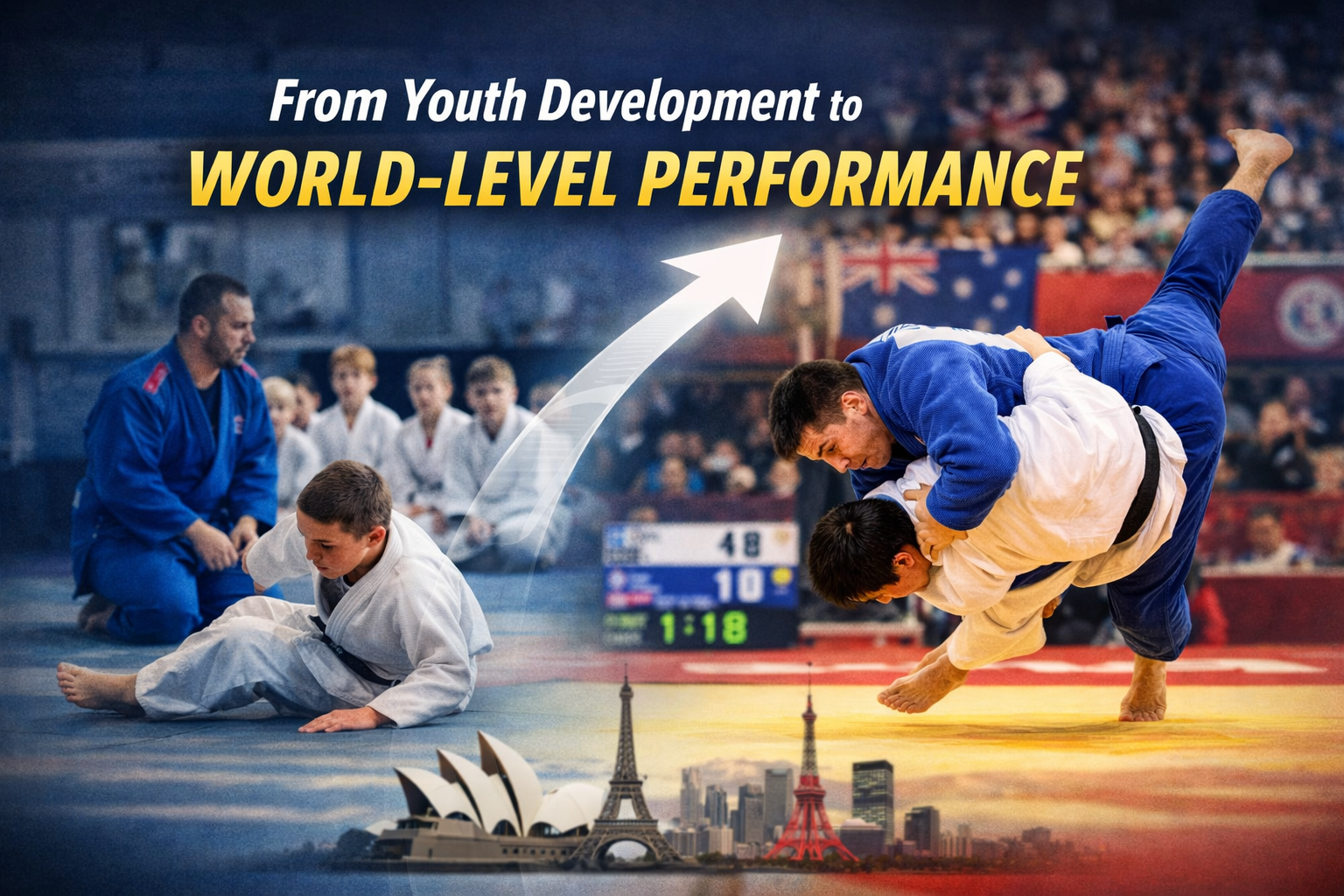
Australia Has Talent — But the Pathway Is Unclear
Australia has many talented young judo athletes.
At the youth level, it is common to see strong physical ability, good coordination, and enthusiasm for competition.
However, as athletes progress into junior and senior categories, many of these promising judoka begin to plateau.
Despite early success, only a small number transition smoothly to consistent high-level performance.
The issue is not a lack of talent.
The issue is the lack of a clear, long-term development pathway.
Why Promising Athletes Stop Progressing
Enjoyment Without Long-Term Structure
Enjoyment is essential, especially for young athletes.
But enjoyment alone does not create high-level performance.
When training lacks structure and progression, athletes may have fun but fail to develop the skills needed for future stages.
This often results in early success followed by stagnation.
Competition Before Technical Readiness
Another common issue is competition being prioritized too early.
Athletes are pushed into frequent tournaments before mastering basic movement, balance, and technique.
While short-term results may look positive, technical gaps eventually appear — usually at the junior or senior level, where the physical and tactical demands increase sharply.
Lack of a Clear Development Timeline
In many cases, there is no clear answer to the question:
“What should this athlete be learning at this age?”
Without defined stages of development, training becomes reactive rather than intentional.
This makes long-term progress inconsistent and unpredictable.
What World-Class Judo Systems Do Differently
Fundamentals Come Before Results
In world-class judo systems, fundamentals are non-negotiable.
Correct posture, movement, gripping, and falling skills are developed before competitive success is emphasized.
This foundation allows athletes to adapt, improve, and stay healthy over long careers.
Patience Is a Coaching Skill
Patience is often underestimated in coaching.
Resisting the urge for immediate results requires confidence, experience, and responsibility.
High-level systems understand that true development cannot be rushed.
Progress is measured over years, not months.
Each Stage Has a Purpose
Youth, junior, and senior stages are not the same.
Each has a specific role in the athlete’s development.
When stages are respected, athletes arrive at senior competition prepared — not burned out or injured.
From Safe Movement to Elite Performance
Why Safety and Correct Falling Matter
One of the unique values of judo is learning how to fall safely.
This skill builds confidence, reduces fear, and allows athletes to train with intensity over long periods.
Safety is not separate from performance — it is the foundation of it.
Technical Precision Builds Confidence
When techniques are taught correctly from the beginning, athletes develop trust in their movement.
This confidence transfers directly into competition.
Strong fundamentals free athletes to focus on tactics, timing, and decision-making under pressure.
A Development Model Built on Results, Not Theory
Results Are a Byproduct of the Environment
Elite performance is not accidental.
It emerges from an environment where fundamentals, structure, and long-term vision are aligned.
Results should not be chased — they should emerge naturally from the process.
This approach is not based on theory, but on experience at the highest levels of judo.
If you’re interested in how early success can affect long-term development, see this article:
”Why Early Success Can Limit Long-Term Judo Development“
Building the Future of Australian Judo
Development Is a Long-Term Responsibility
Coaching is a responsibility, not only to today’s results, but to the athlete’s future.
By focusing on correct development, we protect athletes, maximize potential, and contribute to the long-term growth of Australian judo.
The goal is not just to produce winners —
but to build a system that consistently produces capable, resilient, world-level athletes.
And if you want to explore the specific training fundamentals that build world-level judoka, read:
“The Fundamentals That Build World-Level Judoka“
For a complete structured pathway, read our youth judo development framework.
If you are looking for kids judo classes on the Gold Coast,
Hirose Judo Academy offers structured training focused on
long-term athlete development.
Learn more about our Kids Judo Classes on the Gold Coast.
Structured Judo Development
Want to see how long-term development is applied in practice?
Explore our kids judo program on the Gold Coast and see how structured training can support confidence, discipline, and long-term progress.