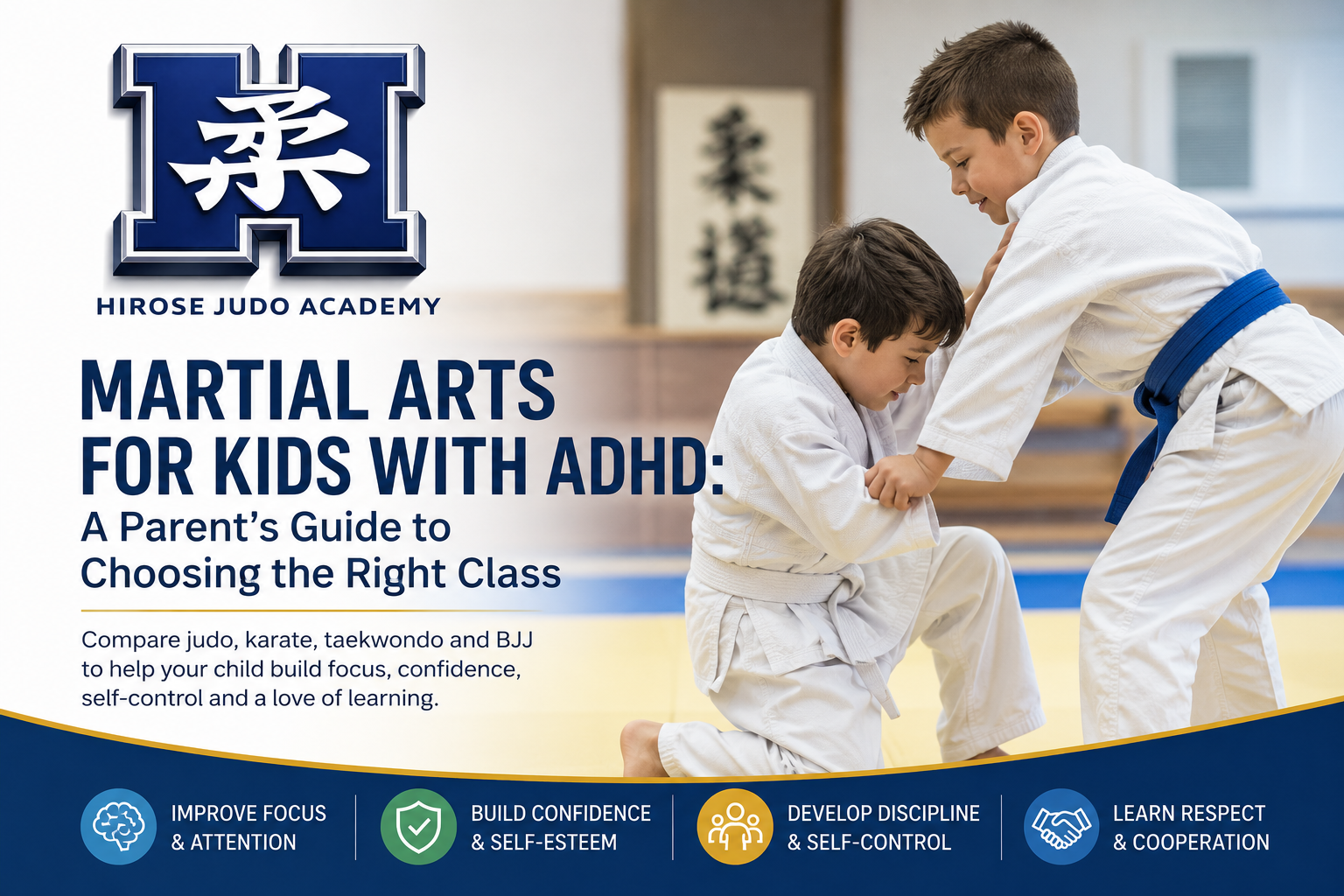
Martial arts can provide movement, routine, challenge and a sense of progress. However, there is no single style that is automatically best for every child with ADHD. The right choice depends on the child, the coach, the class structure and how the learning environment responds to individual needs.
Judo, karate, taekwondo and Brazilian jiu-jitsu can all be suitable for children with ADHD. Judo may particularly appeal to children who learn through movement, enjoy hands-on partner activities and benefit from short, practical tasks. Karate may suit children who prefer repetition and individual drills, while taekwondo can suit those who enjoy fast movement and kicking. Brazilian jiu-jitsu may appeal to children who enjoy physical puzzles and groundwork.
The martial art’s name is less important than finding a patient coach, clear routines, appropriate challenge and a class in which the child feels safe and included.
Why Parents Consider Martial Arts for Kids with ADHD
Parents are often not simply searching for another sport. They may be looking for an activity where their child can move, experience success, develop confidence and become part of a positive community.
Some children with ADHD find activities involving long periods of waiting or listening particularly difficult. A well-organised martial arts class can offer a different type of learning experience because instructions are often followed quickly by movement, demonstration and practice.
Parents may consider martial arts because they hope it will provide:
A productive way to move
Martial arts classes can give children a purposeful physical outlet rather than expecting them to remain still for long periods.
A predictable routine
Repeated class structures, familiar rules and consistent expectations can make the learning environment easier to understand.
Visible progress
Learning a new breakfall, throw, stance or sequence can give children clear evidence that practice leads to improvement.
Confidence through ability
Children may become more confident when they learn practical skills and experience manageable challenges, rather than receiving praise without a clear achievement.
Social interaction
Partner practice may provide structured opportunities to communicate, cooperate, take turns and respond to another person.
A sense of belonging
A supportive club can give children a community in which progress is recognised and differences are handled patiently.
What Makes a Martial Art Suitable for a Child with ADHD?
The style itself is only one part of the decision. Two clubs teaching the same martial art may provide completely different experiences.
A child who struggles in a crowded, noisy and unpredictable class may respond very differently in a class with calm instruction, short explanations and clear transitions. For that reason, parents should evaluate the way the class is taught rather than choosing only by the martial art’s reputation.
1. Clear and concise instructions
Instructions should be broken into manageable steps. A coach who explains one or two points and then allows children to practise may be easier to follow than a coach who gives long verbal explanations.
2. A consistent class structure
A familiar sequence—such as warm-up, technical practice, partner drills and a final activity—can help children understand what is happening next.
3. Movement-based learning
Some children engage more successfully when they can immediately practise what they have seen rather than waiting through a long explanation.
4. Positive but firm coaching
Supportive coaching does not mean having no boundaries. Children generally benefit from calm correction, clear expectations and consistent consequences without humiliation or intimidation.
5. Short, achievable goals
Breaking a skill into smaller stages allows the child to experience progress more frequently and understand exactly what to work on next.
6. Thoughtful partner matching
In partner-based martial arts, the coach should consider size, experience, temperament and the child’s ability to practise safely with others.
7. Appropriate class size
Large classes are not automatically unsuitable, but the instructor must still be able to supervise properly, redirect children and prevent the environment from becoming chaotic.
8. Time to settle in
Some children need more than one lesson before they understand the routine and feel comfortable. A good coach does not judge the child’s long-term potential from one uncertain first class.
The same coaching, safety and class-culture principles apply when choosing a judo club. Read How to Choose a Judo Club for Kids for a detailed checklist covering supervision, beginner instruction and long-term development.
Best Martial Arts for Kids with ADHD: Side-by-Side Comparison
There is no universal ranking that applies to every child. The following comparison can help parents understand the typical learning style of each martial art, but class structure varies significantly between clubs.
| Martial art | Main learning style | Potential strengths | Points to consider |
|---|---|---|---|
|
Judo Movement and partners |
Throws, safe falling, balance, gripping, groundwork and live partner movement | Hands-on learning, short practical tasks, physical problem-solving, clear rules and frequent partner interaction | Close physical contact may take time to become comfortable. Safe partner matching and controlled progression are essential. |
| Karate | Stances, strikes, blocks, forms and repeated technical drills | Predictable repetition, individual practice, clear technical sequences and visible grading goals | Some classes involve long periods of standing in lines or repeating movements, which may not suit every child. |
| Taekwondo | Kicking, fast movement, patterns, flexibility and sparring | High-energy movement, dynamic skills, visible belt progression and athletic activity | The pace, noise and class size can vary. Parents should observe how waiting time and transitions are managed. |
| Brazilian jiu-jitsu | Ground positions, escapes, control, submissions and partner problem-solving | Physical puzzles, close partner engagement, detailed skill progression and hands-on learning | Groundwork can involve sustained close contact. The quality of supervision and rules around submissions are especially important for children. |
Judo may suit a child who:
- Enjoys learning by moving rather than only listening
- Likes active partner-based games and exercises
- Benefits from short tasks with immediate feedback
- Enjoys physical puzzles and reacting to movement
- Can gradually become comfortable with close contact
Karate may suit a child who:
- Enjoys repeating techniques independently
- Responds well to formal routines and sequences
- Prefers less physical contact during early lessons
- Likes working toward precise technical movements
Taekwondo may suit a child who:
- Enjoys kicking, jumping and fast whole-body movement
- Likes energetic drills and visible progression
- Responds well to a lively class atmosphere
Brazilian jiu-jitsu may suit a child who:
- Enjoys solving detailed physical problems
- Prefers groundwork to standing techniques
- Can remain engaged while working through positions step by step
Why Judo May Suit Some Children with ADHD
Judo combines clear rules with constant movement. Children are not only asked to watch a technique; they normally have an opportunity to practise it with a partner shortly afterwards.
This learn-by-doing format may suit children who find it easier to engage with practical, physical tasks than with long verbal explanations.
Immediate physical feedback
A child can feel whether their balance, posture or movement worked. This can make technical feedback more concrete and easier to understand.
Skills can be divided into small steps
Safe falling, foot movement, gripping and throwing can be taught progressively. Children do not need to master the full technique immediately.
Partners require attention
A training partner moves and reacts. The child must notice distance, balance and timing rather than performing every task in isolation.
Mistakes are part of practice
Losing balance, missing a movement and trying again are normal parts of judo. This can create regular opportunities to practise responding to frustration.
Clear boundaries are essential
Judo requires children to stop when instructed, protect their partner and use techniques only within the agreed rules.
Progress can become visible
A skill that initially felt impossible may gradually become familiar. This visible progress can contribute to a stronger sense of competence.
For many parents, the deeper goal is not simply improving concentration—it is helping their child feel more capable. Read Does Judo Build Confidence in Kids? to understand how confidence can develop through skill, safe challenges and consistent progress.
ADHD does not look the same in every child. Some children may also be shy, anxious in new environments or hesitant about partner contact. Read Is Judo Good for Shy Kids? for guidance on introducing a cautious child to judo gradually.
Can Martial Arts Help a Child with ADHD?
Martial arts should not be described as a treatment or cure for ADHD. ADHD is a neurodevelopmental condition, and participation in judo, karate, taekwondo or Brazilian jiu-jitsu does not replace professional medical, psychological or educational support.
However, a well-structured martial arts class may provide an environment in which some children can practise useful skills such as listening to a short instruction, waiting for a turn, controlling their movement, cooperating with a partner and continuing after a mistake.
What martial arts may provide
- A regular weekly routine
- Purposeful physical activity
- Clear rules and boundaries
- Short-term and long-term goals
- Opportunities to practise self-control
- Positive relationships with coaches and training partners
- A place to experience progress outside school
The results will differ between children. Some may connect strongly with the class, while others may need a different sport, a smaller group, another instructor or additional support.
Focus during an activity is not the same as “fixing” attention
A child may appear highly focused during an activity they find interesting, physical and immediate while still experiencing attention difficulties in other environments. This does not mean that martial arts have removed ADHD.
It may mean that the class is providing conditions that help the child engage: movement, clear feedback, meaningful goals and frequent opportunities to participate.
Can martial arts support emotional regulation?
Martial arts regularly create manageable moments of frustration. A technique may not work, a partner may move unexpectedly or a child may need to wait before trying again.
In a supportive class, the coach can help the child pause, listen, reset and continue. Over time, these repeated experiences may give some children opportunities to practise responding to frustration more constructively.
The key is that the challenge must remain appropriate. A child who is constantly overwhelmed, embarrassed or punished is unlikely to develop healthy self-regulation through that environment.
Can martial arts help build confidence?
Some children with ADHD receive frequent correction in school, at home and in social settings. They may begin to believe that they are always the child who gets things wrong.
Martial arts can offer a different experience. A child may discover that they are good at learning through movement, remembering practical sequences, reacting quickly or solving physical problems.
Confidence is more likely to grow when the child experiences real progress: learning how to fall safely, completing a technique, helping a partner or handling a difficult class more successfully than before.
Confidence does not come simply from receiving praise. It develops when children gain skills and learn that they can manage appropriate challenges. Read Does Judo Build Confidence in Kids? for a deeper explanation.
Is Judo the Best Martial Art for Every Child with ADHD?
No. Judo can be a very good fit for some children, but it is not automatically the best choice for every child with ADHD.
Judo involves close physical contact, partner cooperation, falling, gripping and responding to unpredictable movement. Some children find this engaging and enjoyable. Others may initially find the contact, noise or changing partners uncomfortable.
Judo may be a good fit when the child:
- Enjoys active, hands-on learning
- Likes working with a partner
- Responds well to short practical tasks
- Enjoys physical puzzles and movement
- Can follow important safety instructions
- Is willing to become comfortable with controlled contact gradually
Judo may require extra support when the child:
- Becomes overwhelmed by close contact
- Finds sudden movement or noise highly distressing
- Has difficulty stopping immediately when instructed
- Struggles to practise safely with a partner
- Needs more individual support than the class can provide
- Feels consistently anxious before or during training
These challenges do not necessarily mean the child cannot do judo. They may mean the introduction needs to be slower, the class needs to be smaller or the coach needs more information about how to support the child.
Should Parents Tell the Martial Arts Coach About ADHD?
In many cases, giving the instructor some practical information before the first class can help. The purpose is not to label the child or ask the coach to lower all expectations. It is to help the instructor understand how the child learns and what may support a successful introduction.
Parents might briefly explain:
- Whether the child benefits from short instructions
- Whether loud or crowded environments can be overwhelming
- Whether physical contact may need to be introduced gradually
- What helps the child reset when frustrated
- Whether there are relevant safety or medical considerations
- What has worked well in other sports or learning environments
The conversation does not need to become a detailed medical discussion. A few useful, practical points may be enough to help the coach begin appropriately.
What Age Can a Child with ADHD Start Martial Arts?
There is no single starting age that applies to every child. Readiness depends on the individual child and the structure of the class.
A child does not need perfect concentration before beginning. However, they should be able to participate safely with suitable support and respond to essential instructions such as stopping, waiting and protecting a partner.
Ages 4–5
Classes should be short, playful and focused on movement, listening, balance and simple routines. Long technical explanations are usually unsuitable.
Ages 6–8
Many children can begin learning basic techniques, partner rules and short skill sequences when instruction is clear and activity changes are managed well.
Ages 9 and over
Older children may be ready for more detailed technical learning and longer classes, but they may still benefit from short explanations, visible goals and regular movement.
Starting later is not a disadvantage. A positive and age-appropriate beginning is more important than enrolling as early as possible.
For a fuller explanation of readiness, class length and age-appropriate expectations, read What Age Should Kids Start Judo? .
What Parents Should Observe During a Trial Class
A trial class is not only a test of the child. It is also an opportunity for the parent to assess the instructor and learning environment.
It is normal for a child to be uncertain, distracted or hesitant during a first lesson. The more important question is how the coach responds.
-
Are instructions short and understandable?
The coach should avoid unnecessary explanations and demonstrate what the child needs to do. -
Does the class move between activities smoothly?
Long periods of waiting and confusing transitions can make participation much harder. -
Does the coach redirect without humiliation?
Correction should be calm, clear and respectful. Public embarrassment is not an effective teaching method. -
Are boundaries consistent?
Children should understand what behaviour is expected and what rules protect their training partners. -
Is the child given an achievable starting point?
A beginner should not be expected to perform at the same level as children who have trained for months or years. -
Are partners selected thoughtfully?
Size, experience, confidence and behaviour should be considered during partner work. -
Does the child receive opportunities to succeed?
Success may be as simple as joining the warm-up, completing one movement or listening well during a short activity. -
Does the child want to return?
Enjoyment alone is not the only consideration, but a willingness to come back is an important sign of potential long-term participation.
Signs a Martial Arts Class May Be a Good Fit
Encouraging signs
- The child is willing to attend again
- The coach remembers and supports the child
- Instructions are clear and consistent
- The child gradually understands the class routine
- Mistakes are corrected without embarrassment
- The child experiences small but genuine successes
- Partner practice remains safe and controlled
- Confidence grows without pressure to be perfect
Warning signs
- The child is regularly humiliated or shouted at
- The class is chaotic and poorly supervised
- Unsafe behaviour is repeatedly ignored
- The instructor sees ADHD only as bad behaviour
- The child is constantly overwhelmed without support
- Beginners are placed into intense sparring immediately
- The coach refuses reasonable communication with parents
- The child becomes increasingly fearful of attending
One difficult lesson does not always mean the class is unsuitable. Children can have tired, emotional or distracted days. Look for the overall pattern across several classes rather than expecting every session to be perfect.
Should Children with ADHD Compete in Martial Arts?
Competition is optional. A child can gain fitness, confidence, friendships and technical skills without entering tournaments.
Some children enjoy clear goals, excitement and the chance to test their skills. Others find the waiting, noise, unfamiliar environment and pressure of competition difficult.
Before entering a competition, consider whether the child can:
- Understand the basic rules
- Follow safety instructions
- Accept that winning is not guaranteed
- Wait through delays and schedule changes
- Manage an unfamiliar venue with support
- Return to training after a disappointing result
Competition should be introduced as one possible learning experience, not as proof of the child’s value or the only measure of progress.
How Parents Can Support Progress Outside the Class
Parents can help by keeping expectations realistic and focusing on consistent participation rather than demanding immediate changes in behaviour.
- Prepare the uniform and equipment before leaving home
- Arrive early enough to avoid a rushed transition
- Explain the basic class sequence before entering
- Set one simple goal for the lesson
- Praise effort, recovery and cooperation—not only winning
- Avoid analysing every mistake immediately after class
- Keep communication with the coach brief and constructive
- Allow enough time for the child to settle into the routine
Choosing Between Judo, Karate, Taekwondo and BJJ
Parents do not need to find a style that is universally considered best for ADHD. They need to find a class that suits their child’s learning style and provides safe, consistent instruction.
A practical decision may look like this:
- Consider judo for hands-on movement, partner interaction, balance and physical problem-solving.
- Consider karate for structured repetition, individual drills and precise technical sequences.
- Consider taekwondo for dynamic kicking, energetic movement and visible belt progression.
- Consider Brazilian jiu-jitsu for detailed groundwork, positional problem-solving and sustained partner engagement.
Visit more than one club when possible. A child may respond very differently to two instructors teaching the same martial art.
Final Thoughts: What Is the Best Martial Art for a Child with ADHD?
There is no single answer for every child. Judo, karate, taekwondo and Brazilian jiu-jitsu can all provide valuable experiences when taught in a safe, structured and supportive environment.
The best class is likely to be one where:
- The child feels safe and respected
- The coach communicates clearly
- Movement and waiting time are balanced appropriately
- Rules are consistent
- Progress is broken into achievable steps
- Individual differences are handled patiently
- The child gradually becomes more willing and confident
Judo may be particularly suitable for children who enjoy active learning, physical problem-solving and partner work. However, the instructor and class culture remain more important than the name of the martial art.
The goal is not to find an activity that promises to “fix” a child. It is to find a place where the child can move, learn, experience meaningful progress and feel that they belong.
Frequently Asked Questions
Are martial arts good for kids with ADHD?
Martial arts can be a positive activity for some children with ADHD when the class offers clear routines, short instructions, purposeful movement and supportive coaching. However, martial arts are not a treatment or cure for ADHD, and the experience depends greatly on the individual child and instructor.
What is the best martial art for a child with ADHD?
There is no single best style for every child. Judo may suit children who enjoy movement and partner work. Karate may suit children who prefer repetition and individual drills. Taekwondo may appeal to children who enjoy fast movement and kicking, while Brazilian jiu-jitsu may suit children who enjoy groundwork and physical problem-solving.
Is judo suitable for children with ADHD?
Judo may suit children who learn well through movement, enjoy hands-on activities and respond positively to short practical tasks. Because judo involves close physical contact and partner safety, the coach must introduce training gradually and maintain clear boundaries.
Can martial arts improve concentration?
A well-structured class may give children opportunities to practise listening, following short instructions and returning attention to a task. This does not mean martial arts remove ADHD or guarantee improved concentration in every environment.
Can martial arts replace ADHD treatment or therapy?
No. Martial arts are a recreational and educational activity, not a replacement for medical care, therapy, school support or other professional recommendations.
Should I tell the instructor that my child has ADHD?
Sharing brief, practical information can help the instructor support the child. Explain what helps with instructions, transitions, frustration or sensory discomfort rather than providing only a diagnostic label.
What age can a child with ADHD start martial arts?
Many children can start an age-appropriate class from around five or six, but readiness varies. The child should be able to participate safely with support and respond to essential instructions such as stopping and protecting a partner.
Is martial arts safe for an impulsive child?
Safety depends on the level of impulsivity, the class structure and the quality of supervision. The instructor must be able to set clear boundaries, match partners appropriately and stop unsafe behaviour immediately.
Does a child with ADHD have to compete?
No. Competition is optional. Children can train for enjoyment, confidence, fitness, friendships and skill development without participating in tournaments.
Try Kids Judo on the Gold Coast
Hirose Judo Academy welcomes children with different personalities, learning styles and levels of experience. Our classes focus on clear instruction, safe progression, strong fundamentals, confidence and long-term development.
A trial class allows your child to experience the environment before your family makes a long-term decision.