
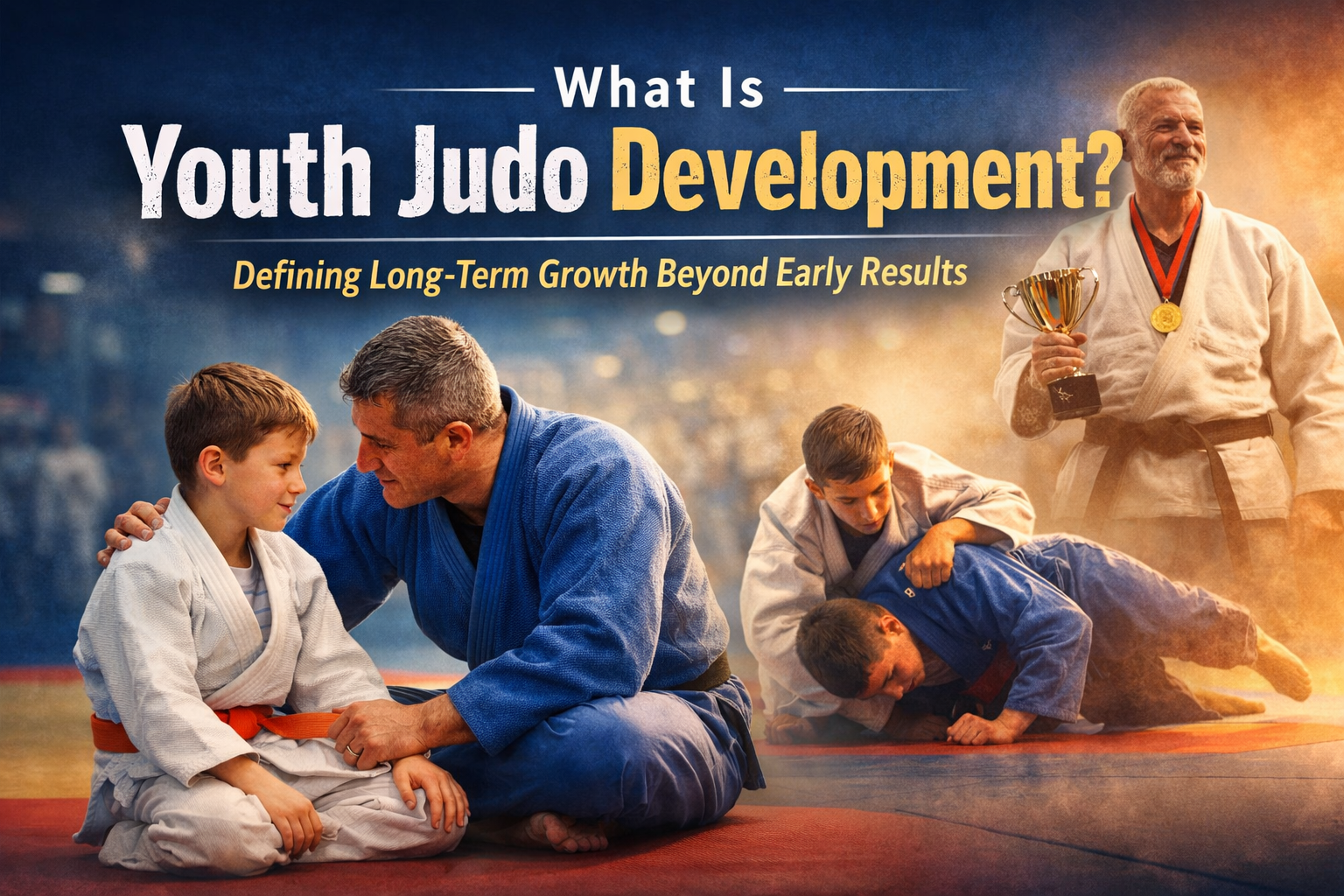
Introduction: Youth Judo Is Often Misunderstood
Youth judo is often judged by one simple metric: results.
Who wins medals.
Who dominates competitions early.
Who looks strong right now.
But youth judo development is not about producing short-term winners.
It is about building athletes who can continue to grow for 10–15 years.
To understand youth judo properly, we must first redefine what “development” actually means.
What Does Youth Judo Development Really Mean?
Youth judo development is the long-term process of building an athlete, not the short-term process of collecting results.
True development focuses on:
- technical foundations
- body control and movement quality
- the ability to learn and adapt
- emotional stability under pressure
Winning matches can happen along the way, but it is never the primary goal.
Development answers a different question:
The Common Mistake: Confusing Winning With Development
One of the biggest mistakes in youth judo is confusing early success with proper development.
Young athletes often win because:
- they mature earlier physically
- they are stronger than their peers
- they rely on limited but effective techniques
These advantages disappear over time.
When physical differences even out, many early winners struggle — not because they lack talent, but because their technical and developmental base is shallow.
This is why early results can be misleading.
🔗 Related reading:
Why Early Success Can Limit Long-Term Judo Development
What Youth Judo Development Should Focus On
Proper youth judo development prioritizes foundations over shortcuts.
Key areas include:
Fundamental movement
Balance, coordination, posture, and efficient movement patterns must be developed before intensity increases.
Technical depth
Athletes should learn to throw with correct gripping, kuzushi, and control — not rely on one-handed or strength-based techniques.
Groundwork (ne-waza)
Groundwork develops control, patience, and problem-solving.
Unlike standing techniques, progress in ne-waza is more equal and less dependent on physical maturity.
🔗 Related reading:
The Fundamentals That Build World-Level Judoka
Development Is Age-Specific
Youth judo must change depending on age and growth stage.
Training that is appropriate at one age can be harmful at another.
For example:
- Ages 6–12: learning movement, safe falling, basic throwing mechanics
- Ages 13–15: expanding technical range while managing growth differences
- Avoiding early specialization and result-driven coaching
🔗 Related reading:
Age-Appropriate Judo Development: What to Train and When
Why Losing Can Be Part of Correct Development
In true youth development, losing is not failure.
Athletes who lose while learning correct technique often build:
- resilience
- deeper understanding
- long-term confidence
Short-term losses can support long-term success.
This requires patience — from athletes, coaches, and parents.
🔗 Related reading:
Long-Term Athlete Development in Judo
Youth Judo Is a Long-Term Investment
Youth judo development is not about creating champions today.
It is about creating athletes who:
- stay in the sport
- continue improving
- reach their physical and technical potential
When development is done correctly, results appear naturally — often later, but far more sustainably.
Conclusion: Redefining Success in Youth Judo
Youth judo should not ask:
Who wins the most at 12?
It should ask:
Who is still improving at 22?
Development is quiet.
Progress is often invisible.
But when built correctly, the foundation becomes too strong to collapse.
For a complete structured pathway, read our youth judo development framework.
If you are looking for kids judo classes on the Gold Coast,
Hirose Judo Academy offers structured training focused on
long-term athlete development.
Structured Judo Development
Want to see how long-term development is applied in practice?
Explore our kids judo program on the Gold Coast and see how structured training can support confidence, discipline, and long-term progress.